
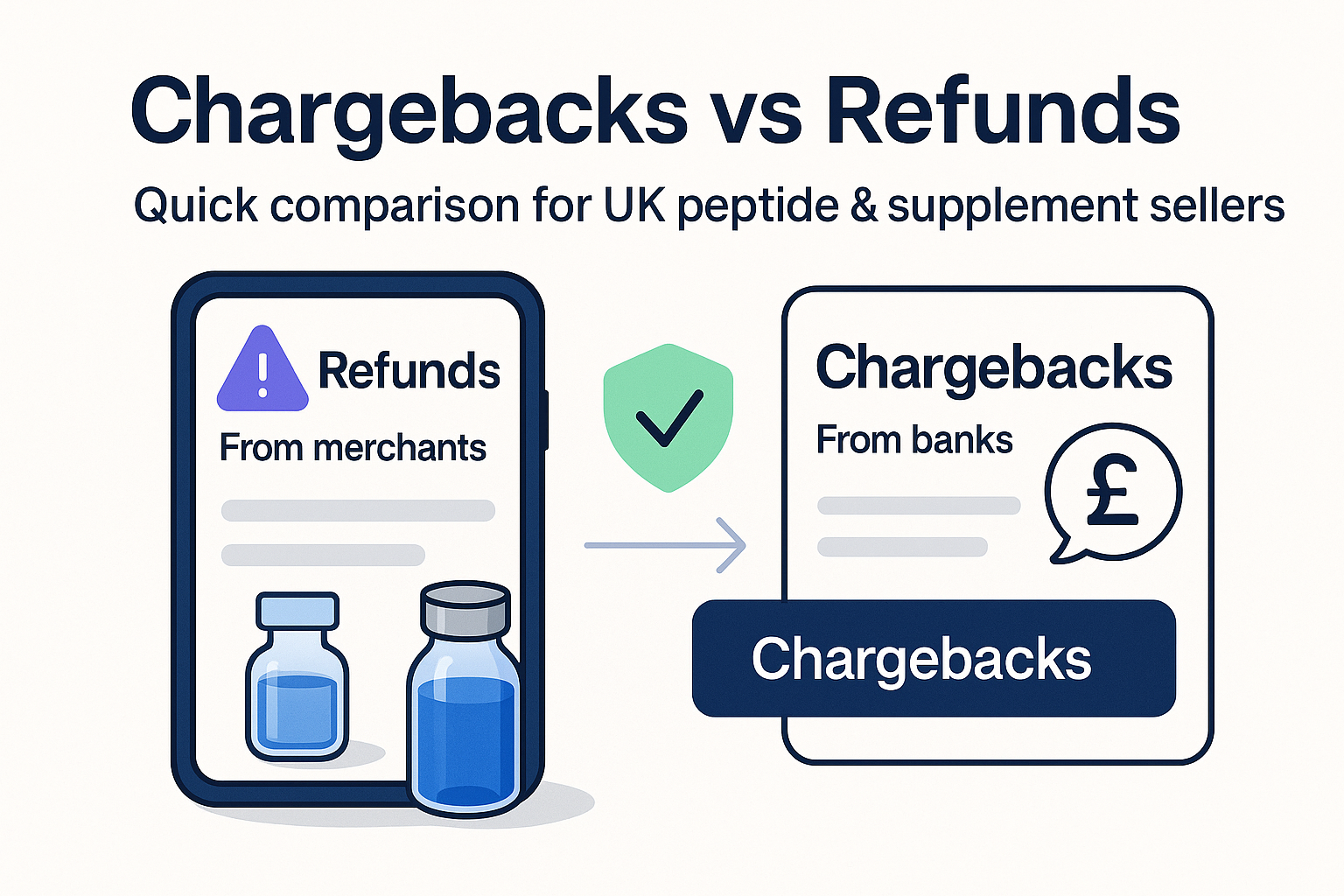
For UK merchants selling peptides, supplements, or any regulated consumer product, post-purchase risk can be just as important as pre-purchase marketing. Refunds, chargebacks, and consumer rights shape your margins, your compliance profile, and your long-term business stability — especially if you operate in a high-risk merchant category.
This guide breaks down what every peptide seller should know about chargebacks, chargeback prevention, refund policies, and why Open Banking payments are becoming a preferred solution for reducing disputes.
This guide breaks down what every peptide seller should know about chargebacks, chargeback prevention, refund policies, and why Open Banking payments are becoming a preferred solution for reducing disputes.
Understanding Refunds, Returns & UK Consumer Rights
Consumers in the UK benefit from strong rights that protect them when shopping online. The Consumer Rights Act 2015 ensures that products must be as described, of satisfactory quality, and fit for purpose. If these conditions aren’t met, the buyer may be entitled to a refund, repair, or replacement. Alongside this, the Consumer Contracts Regulations introduce the well‑known 14‑day cancellation window, giving customers the ability to change their mind after receiving an online order.
For peptide sellers, the rules require special attention. Many products fall under research‑only classifications or may be unsafe to return once opened. Because of this, your refund policy must clearly explain what is and isn’t eligible for return, helping you remain compliant and reducing the likelihood of disputes.
What Is a Chargeback?
A chargeback occurs when a customer disputes a payment directly with their bank, who may then forcibly reverse the transaction. Disputes often arise from issues such as non‑delivery, products not matching expectations, concerns about safety or authenticity, or simply a breakdown in communication. In some cases, customers initiate chargebacks instead of contacting support, using the process as a shortcut to a refund.
Chargebacks can be expensive. Beyond losing the product and the payment itself, merchants face additional bank fees and the administrative burden of defending the case. High‑risk industries, including peptide and supplement sellers, face even stricter scrutiny. Exceeding a chargeback ratio of around 1% can lead to frozen accounts or even permanent removal from some payment providers.
Why Peptide Sellers Are Treated as High-Risk
Payment processors classify merchants based on industry risk. Peptide sellers typically fall under:
- Supplements
- Research chemicals
- Health & performance products
- Products with regulatory ambiguity
This means:
- Higher likelihood of disputes
- Higher chargeback ratios
- Stricter underwriting
- Need for a high-risk merchant account
Warning for Shopify Stores
Shopify Payments may disable merchants operating in restricted categories — peptides often fall under review triggers for:
- “Medical claims”
- “Unregulated compounds”
- “Performance enhancement”
This creates Shopify chargeback exposure because third-party processors may apply even stricter rules.
Common Causes of Chargebacks in Peptide & Supplement Niches
Chargebacks in the peptide space usually stem from predictable patterns. Operational challenges like slow shipping, missing tracking updates, or low‑detail packaging often create uncertainty for buyers. Compliance issues — such as unclear product information, accidental health claims, or regulatory ambiguity — can also trigger disputes.
Sometimes the cause is policy‑related. If your refund or return terms are difficult to find, unclear, or feel restrictive, customers are more likely to bypass your support team and go straight to their bank. And finally, there are customer‑driven motivations: buyer’s remorse, misunderstandings, or even cases of deliberate misuse of the chargeback process.
Chargeback Prevention Strategies for Peptide Sellers
Reducing chargebacks begins with clarity. A transparent and easy‑to‑read refund policy helps set accurate expectations and reduces misunderstandings. For peptide sellers, this includes clearly stating conditions for returns, describing which products cannot be accepted back once opened, and outlining realistic timelines for processing refunds.
Strengthening product information also helps. Avoid medical claims, ensure your descriptions match what customers will receive, and provide realistic delivery estimates. Good communication throughout the fulfilment journey — including tracking links and dispatch notifications — goes a long way in preventing disputes.
Identity verification tools such as KYC checks or 3DS authentication reduce fraud‑related disputes, while Open Banking payments provide the strongest safeguard of all. Because these payments cannot be forcibly reversed through chargebacks, merchants gain predictable revenue and eliminate one of the most common sources of risk in high‑risk ecommerce.
How to Build a Refund Policy for a Peptide Store
A strong refund policy answers the questions customers are most likely to ask. For peptide products, it’s important to explain whether opened items can be returned (in most cases, they cannot), whether the 14‑day return window applies, and what steps a customer should follow to request a refund.
Below is a simplified, reader‑friendly template:
- Refund Eligibility: Products may be returned within 14 days if they are unopened, unused, and in their original packaging.
- Non‑Returnable Items: Opened vials, temperature‑sensitive goods, customised items, and discounted products are typically not eligible for return.
- Requesting a Refund: Customers should contact your support team with their order number to begin the process.
- Processing Time: Refunds are generally issued within 14 days once the return has been inspected.
- Shipping Costs: Delivery fees are usually non‑refundable.
Dispute Resolution: Chargebacks vs. Refunds
Open Banking Payments: A Game-Changer for High-Risk Sellers
Peptide and supplement brands are adopting Open Banking faster than almost any other ecommerce segment because:
Benefits:
- No chargebacks
- Instant settlement
- High success rate
- Lower fees vs. traditional processors
- Biometric authentication removes fraud
- Works seamlessly in Shopify, WooCommerce, and custom stores
Why “No Chargebacks” Matters
For high-risk merchants:
- Chargeback ratios can be fatal
- Card processors often remove support
- Shopify Payments may freeze accounts
Open Banking eliminates these issues entirely.

