
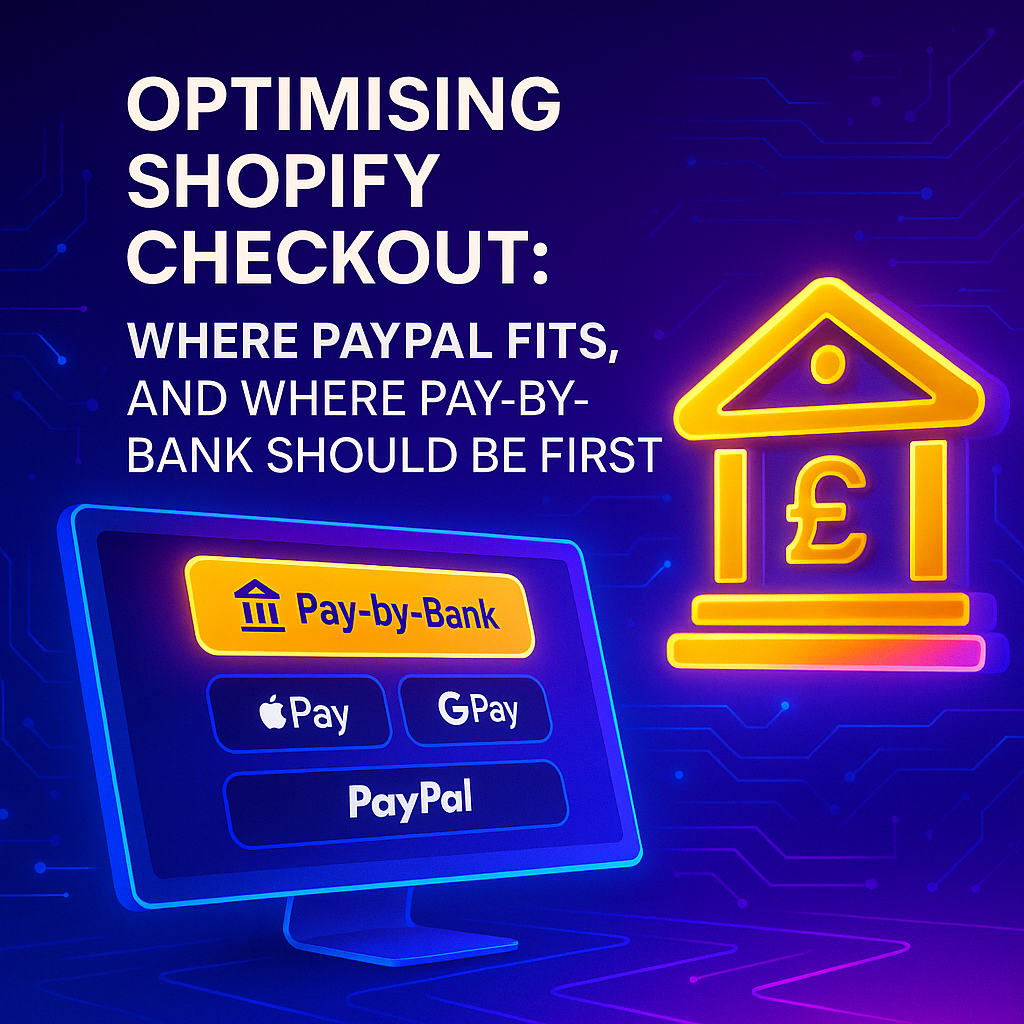
The fastest way to increase Shopify conversion rate in 2025 is not another theme tweak or an abandoned-cart sequence. It is checkout UX optimisation — specifically, how payment methods appear, in what order, and how much friction they create on mobile.
Most UK merchants unknowingly lose conversions because their checkout buttons are not arranged for speed, biometric certainty, or lowest fee routing. They rely on PayPal because it is familiar, but rarely test what happens when Pay-by-Bank becomes the first actionable tap.
Most UK merchants unknowingly lose conversions because their checkout buttons are not arranged for speed, biometric certainty, or lowest fee routing. They rely on PayPal because it is familiar, but rarely test what happens when Pay-by-Bank becomes the first actionable tap.
This guide outlines conversion optimisation strategies, grounded in modern UX research and real merchant performance patterns. It focuses on efficient payment processing, secure online payments, and checkout design best practices — without removing PayPal, but placing it where it performs best.
Shopify Checkout Has Changed — UX Now Decides Your Payment Mix
Shopify’s modern one-page checkout allows multiple payment methods, but also makes one truth unavoidable:
The first method that appears fastest wins the conversion.
When customers see a scrollable list of wallets, redirects, and login screens, they default to the most recognisable brand — often PayPal — even if it slows the checkout or increases transaction costs.
Behaviour Shifts in UK Checkout Patterns
- Mobile biometric authentication (Face ID or fingerprint) now defines "fast".
- Customers prefer tap-to-pay experiences without typing.
- Younger buyers avoid account-based flows unless necessary.
Pay-by-Bank aligns naturally with mobile-first behaviour, but its impact depends entirely on placement.
Mobile UX: Why Button Placement Matters More Than Desktop Layouts
Over 70 percent of UK Shopify orders now complete on mobile, meaning:
- Most buyers only see the first one or two payment buttons.
- Scroll depth is minimal.
- Every additional tap creates measurable drop-off.
PayPal’s Mobile Flow
PayPal still requires:
- Email or phone recognition.
- Account login, unless cookies persist.
- Funding source selection.
- Redirect back to Shopify.
This is a multi-screen flow that feels long on mobile, especially under poor connectivity.
Pay-by-Bank’s Mobile Flow
Modern Pay-by-Bank offers:
- Choose bank.
- Biometric confirmation inside the banking app.
- Automatic return to checkout.
No passwords. No username flows. No secondary account management. This is why PBB significantly increases conversion when placed first.
Button Ordering: The Most Overlooked Conversion Lever in Shopify
Most merchants leave PayPal first because "customers expect it." But expectation shifts when a faster, simpler option appears first.
What the Data Shows
- Placing Pay-by-Bank above PayPal consistently increases PBB routing.
- Top-positioned methods absorb the majority of conversions.
- Prioritising PayPal increases transaction costs unnecessarily.
Recommended Payment Method Ordering (2025)
- Pay-by-Bank (biometric, fast, lowest cost)
- Apple Pay or Google Pay
- PayPal
- Standard card entry (Shopify Payments)
This structure gives speed-first methods priority while keeping PayPal accessible for those who specifically want it.
Wallet Friction Versus Biometric Bank Payments
Customers increasingly expect checkout identity to be tied to their device biometrics. Anything else introduces friction.
Where Wallets Add Friction
- Passwords and login screens.
- Redirects and account-loading delays.
- Forgotten credentials.
- Forced funding source selection.
- Variable reliability based on cookies or device.
How Biometric Bank Payments Remove Friction
- The banking app already verifies identity.
- No credentials to remember.
- No account to maintain.
- Authentication is instantaneous.
For first-time buyers especially, Pay-by-Bank feels more predictable and less intrusive than wallet-based flows.
Where PayPal Is Best Placed in Checkout
PayPal remains important for:
- Older customer demographics.
- Higher average order values.
- International traffic.
- Repeat customers with entrenched PayPal habits.
Optimal PayPal placement:
- Visible but not dominant.
- Secondary to faster mobile-native options.
PayPal works best when it acts as a familiar fallback rather than the default route.
Where Pay-by-Bank Should Be First
Pay-by-Bank should be prioritised when:
- Mobile traffic exceeds 60 percent.
- Reducing fraud or chargebacks is important.
- Checkout completion speed directly affects ROAS.
- Margin impact from payment fees is meaningful.
- Buyers actively use their banking apps.
Impact of Prioritising Pay-by-Bank
Higher conversion: Buyers choose the fastest path.
Lower payment costs: Reduced card and wallet processing fees.
Fewer disputes: Strong bank authentication eliminates many PayPal and card chargeback categories.
Greater checkout resilience: No third-party login failures, rate limits, or wallet outages.