
As e-commerce expands across borders and customer expectations evolve, merchants increasingly look beyond cards and digital wallets. Alternative payment methods are often introduced to capture local demand, improve trust, and reduce checkout friction in specific markets.
However, while adding local options can increase reach, it can also introduce operational and technical complexity. Understanding how alternative payment methods function inside WooCommerce — and what fragmentation means in practice — is essential before expanding your payment stack.
However, while adding local options can increase reach, it can also introduce operational and technical complexity. Understanding how alternative payment methods function inside WooCommerce — and what fragmentation means in practice — is essential before expanding your payment stack.
What Are Alternative Payment Methods?
Alternative payment methods (APMs) refer to online payment methods that are neither traditional card payments nor global digital wallets.
In ecommerce, this category typically includes:
- Bank-based payments
- Account-to-account transfers
- Region-specific checkout options
- Invoice-based or deferred confirmation flows
Merchants adopt alternative payment methods to:
- Align with local payment preferences
- Enter new geographic markets
- Improve perceived trust in specific regions
- Reduce card dependency
The strategic goal is simple: match how customers prefer to pay.
The operational reality is more complex.
Why Merchants Add Local Payment Methods
When expanding into new regions — particularly in the UK or across Europe — customer payment preferences often differ significantly from global card norms.
Local payment methods can:
- Increase checkout familiarity
- Improve authorization confidence
- Reduce perceived payment risk
- Support customers without credit cards
For merchants targeting international payment methods adoption, adding local payment options ecommerce-wide can feel like a necessary step.
But each added method introduces another flow, another confirmation logic, and another reconciliation pathway.
The Hidden Challenge: Payment Method Fragmentation
Fragmentation occurs when multiple alternative payments operate under different technical, operational, and customer experience rules.
This affects three critical layers:
1. Fragmented User Experience
Different methods may:
- Redirect customers off-site
- Require manual bank login
- Use delayed confirmation screens
- Produce inconsistent success messages
The checkout experience becomes inconsistent across payment options, increasing cognitive friction and uncertainty.
2. Inconsistent Confirmation Logic
Unlike card payments that typically authorize instantly, many alternative payment methods:
- Confirm asynchronously
- Rely on webhooks
- Mark orders as pending for extended periods
This creates fulfillment ambiguity. Merchants must decide:
- Ship immediately?
- Wait for confirmation?
- Manually verify?
Operational risk increases as confirmation flows diverge.
3. Operational Overhead
Each alternative payment method can introduce:
- Separate settlement cycles
- Distinct reconciliation processes
- Additional dispute handling logic
- Reporting inconsistencies
For WooCommerce stores, this means more manual oversight inside order management.
As alternative payments scale, administrative complexity compounds.
Visualizing Fragmentation in WooCommerce
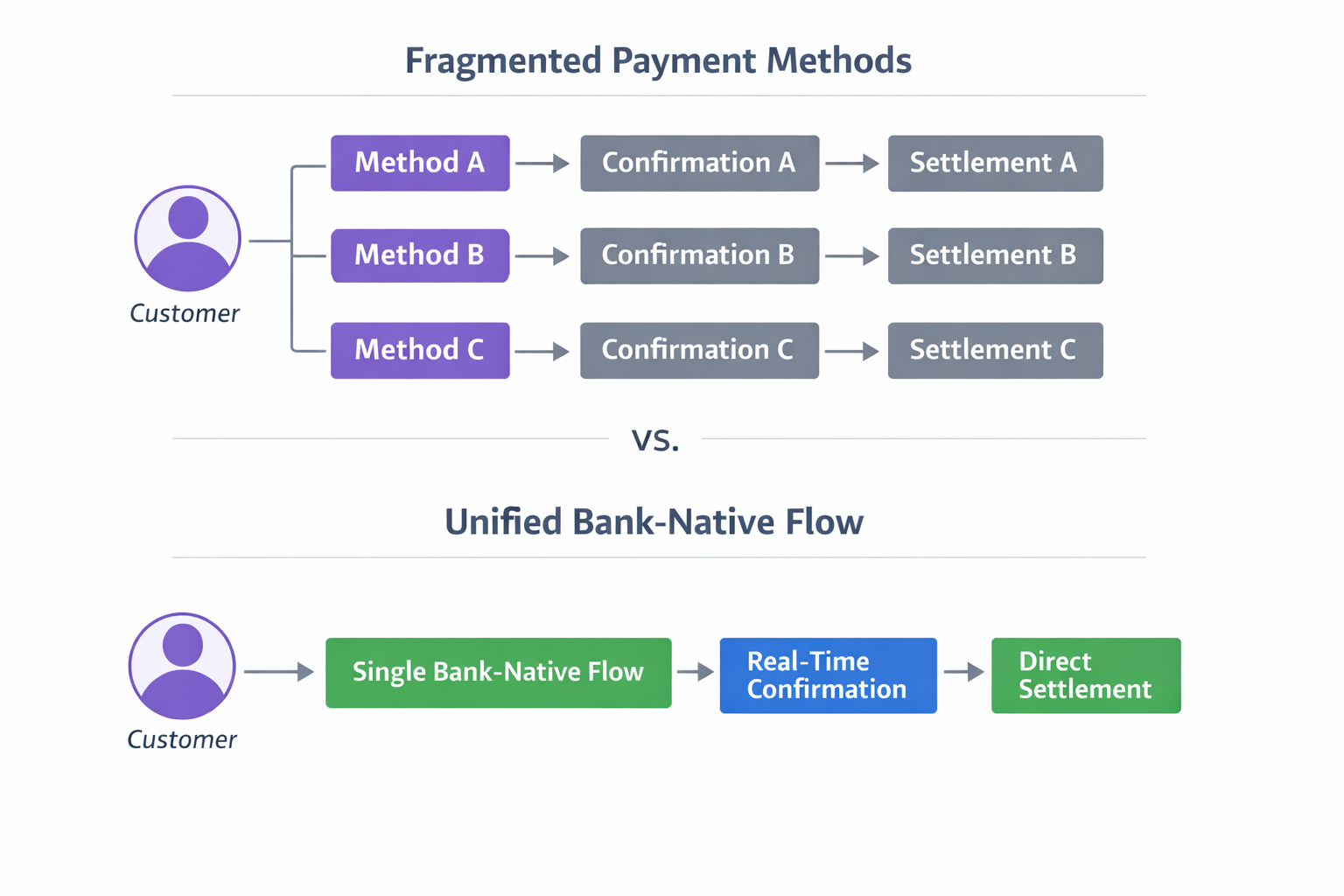
The difference is not the number of buttons at checkout — it is the number of operational systems behind them.
Local Payment Methods in the UK and International Markets
For merchants exploring alternative payments UK-wide or expanding internationally, fragmentation becomes more visible.
Each market may:
- Prefer a different checkout behavior
- Expect local branding
- Require region-specific compliance flows
Adding multiple international payment methods increases geographic coverage — but also multiplies integration and monitoring requirements.
Without orchestration, WooCommerce becomes a collection of payment silos.
Strategic Trade-Off: Coverage vs Complexity
The question is not whether alternative payments are valuable.
The question is whether they are implemented as fragmented layers — or as part of a unified architecture.
A Unified Alternative: Bank-Native Payments
Instead of aggregating multiple local payment methods, some merchants adopt a bank-native approach.
Bank-native payments:
- Connect directly to the customer’s bank
- Provide real-time authorization
- Reduce reliance on card networks
- Consolidate settlement logic
Rather than adding more methods, this model simplifies the payment layer while preserving local trust dynamics.
For WooCommerce merchants concerned about cart abandonment and payment friction, reducing backend complexity often improves checkout clarity.
When Should You Add Alternative Payment Methods?
Consider adding local payment options ecommerce-wide when:
- A specific region represents meaningful revenue opportunity
- Card authorization rates are demonstrably low
- Customer trust barriers are measurable
Avoid reactive expansion based solely on trend pressure.
Alternative payment methods should solve a conversion problem — not create an operational one.
Conclusion
Alternative payment methods play a critical role in modern ecommerce, especially for international growth and regional optimization.
However, in WooCommerce, payment expansion must be balanced against system complexity.
Fragmentation across user experience, confirmation logic, and settlement processes can quietly increase operational risk.
The most resilient payment stacks are not the widest — they are the most coherent.
Understanding how alternative payments integrate structurally is the difference between adding buttons at checkout and building a sustainable payment architecture.

