
Research peptide sellers often face payment challenges that many standard ecommerce businesses never encounter. Banks, card issuers and payment processors frequently classify peptide merchants as high-risk due to regulatory scrutiny, product restrictions and compliance concerns.
As a result, research peptide businesses may experience card payment declines, account reviews, rolling reserves, payout delays or even sudden termination of payment services.
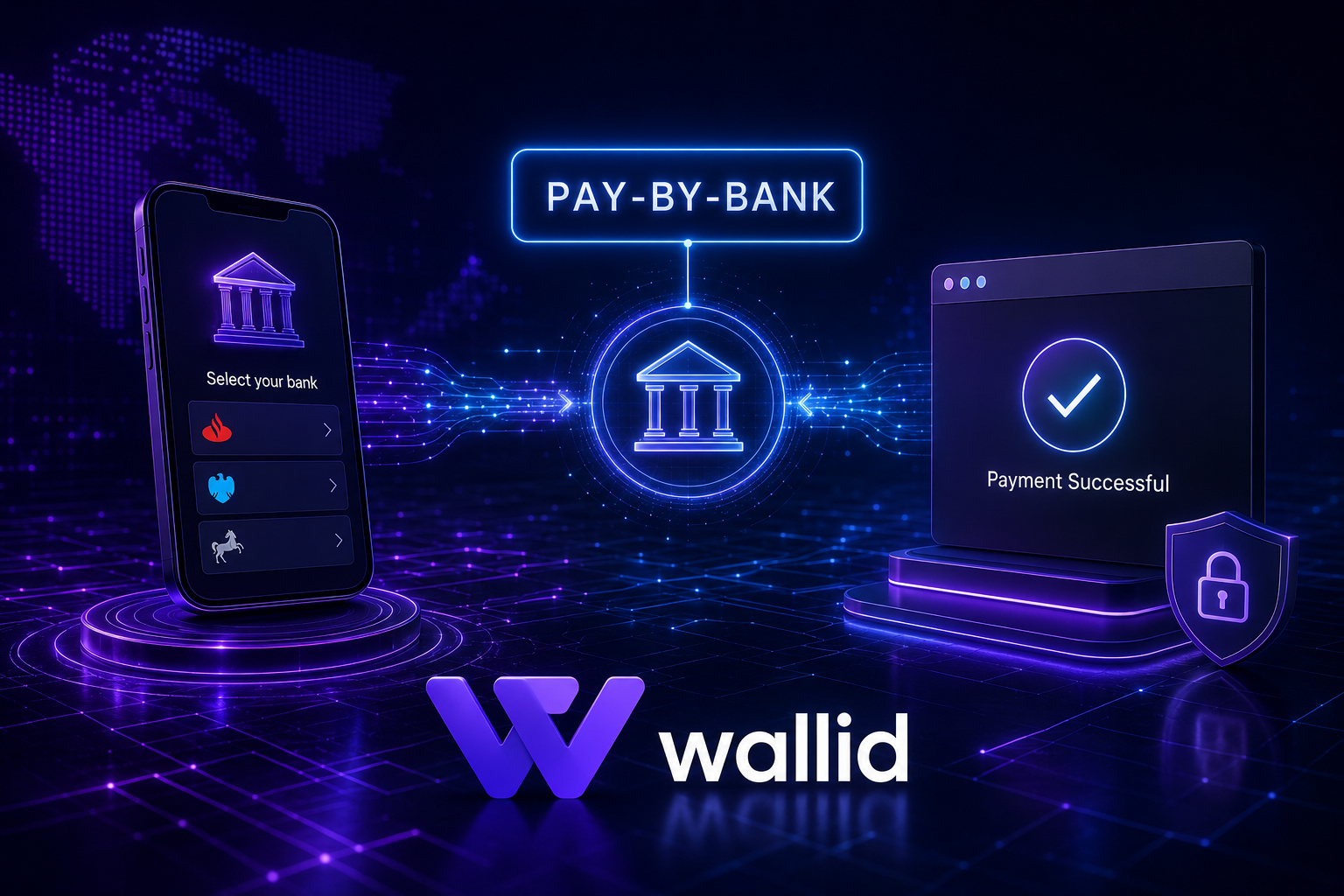
Wallid's Pay by Bank API offers an alternative payment method for eligible research peptide sellers. By enabling direct bank payments through Open Banking technology, merchants can reduce reliance on card networks, eliminate card chargebacks and gain access to a more predictable payment infrastructure.
This article explains how research peptide sellers in the UK and Europe can use a peptide payment API, why traditional payment processing can be challenging for peptide businesses, how Pay by Bank payments work, and what merchants should consider when evaluating payment solutions for research-use peptide ecommerce.
Can Research Peptide Sellers Use Pay by Bank Payments?
Yes. Research peptide sellers can use Pay by Bank payments if their business passes compliance checks and their products are legally positioned for research use.
Wallid's Pay by Bank API allows eligible peptide merchants to accept direct bank payments without relying on card networks, helping reduce card declines, chargeback exposure and payout uncertainty.
Businesses must comply with applicable local laws and pass merchant review before activation.
Why Peptide Sellers Struggle With Payments
Research peptides operate in a category that many payment providers consider higher risk than traditional ecommerce sectors.
The challenge is not always the product itself. Often, it is the uncertainty surrounding how products are marketed, described and sold.
Different payment providers may classify peptide merchants as:
- Research chemical sellers
- Wellness product merchants
- Supplement businesses
- Regulated product retailers
- High-risk ecommerce merchants
This classification can create significant payment friction.
Card Issuers May Decline Transactions
Even when a merchant is approved by a payment processor, individual card issuers can still decline transactions.
Common reasons include:
- Risk scoring systems
- Unfamiliar merchant categories
- Cross-border transactions
- Customer fraud-prevention settings
- Regulatory concerns
These declines can reduce conversion rates and create a poor customer experience.
Account Reviews and Reserves
Many peptide merchants experience additional monitoring compared to lower-risk ecommerce sectors.
Payment providers may impose:
- Rolling reserves
- Enhanced due diligence
- Ongoing compliance reviews
- Delayed settlements
- Temporary account restrictions
In some cases, merchants may be offboarded entirely if a provider changes its risk policies.
For businesses dependent on consistent cash flow, this uncertainty can become a major operational challenge.
Why Research-Use Positioning Matters
Payment approval often depends as much on merchant compliance as on the products themselves.
Research peptide businesses that maintain transparent, compliant operations are generally better positioned for payment review.
Use Clear Research-Only Positioning
Merchants should clearly communicate that products are intended for research use where applicable.
This includes:
- Research-use-only language
- Appropriate product disclaimers
- Accurate product descriptions
- Transparent business information
Avoid Human Consumption Claims
Many payment providers review how products are presented online.
Merchants should avoid:
- Human-consumption claims
- Medical claims
- Therapeutic claims
- Performance-enhancement claims
- Disease-treatment claims
Such statements may increase compliance concerns and affect payment approval.
Maintain Supporting Documentation
Compliance reviews often benefit from clear supporting documentation.
Examples include:
- Certificates of Analysis (COAs)
- Third-party laboratory reports
- Product testing records
- Supplier documentation
- Business registration information
Providing accurate documentation helps demonstrate operational transparency.
Display Clear Policies
Merchants should maintain visible policies covering:
- Shipping
- Returns
- Refunds
- Terms and conditions
- Privacy practices
Clear policies help build trust with both customers and payment providers.
Why Pay by Bank Fits Peptide Ecommerce
Traditional card payments introduce multiple intermediaries between the customer and the merchant.
Card networks, issuing banks, acquiring banks and processors all influence whether a payment succeeds.
Pay by Bank simplifies this process by allowing customers to authorise payments directly from their bank accounts.
For eligible research peptide sellers, this can create a more predictable payment experience.
No Card-Network Routing
Traditional card payments rely on networks such as Visa and Mastercard.
Pay by Bank transactions do not use card rails.
Instead, customers authenticate directly with their bank and authorise the payment through secure Open Banking connections.
This reduces dependence on card-network approval processes.
No Card Chargebacks
One of the most significant advantages for many high-risk merchants is the removal of card chargebacks.
Because Pay by Bank transactions do not use card networks, traditional card chargeback mechanisms do not apply.
This can reduce operational costs, dispute management workloads and revenue uncertainty.
Faster Access to Funds
Many merchants prioritise payment methods that improve cash flow visibility.
Pay by Bank transactions can provide faster payment confirmation and more predictable settlement processes compared with some traditional payment workflows.
For businesses managing inventory, fulfilment and supplier relationships, faster access to funds can support smoother operations.
Lower Payment Uncertainty
Research peptide merchants frequently face payment uncertainty due to:
- Card issuer declines
- Fraud-screening rules
- Risk reviews
- Processor policy changes
By reducing reliance on card infrastructure, Pay by Bank can help create a more stable payment environment for eligible businesses.
Why Wallid Is Built for High-Risk Ecommerce Payments
Many payment providers are designed primarily for mainstream ecommerce sectors.
Research peptide merchants often require a payment solution that understands regulated and higher-risk business models.
Wallid's Pay by Bank API is designed to support eligible merchants that may encounter challenges with traditional card-based payment systems.
Benefits include:
- Direct bank payment authorisation
- No card-network dependency
- No card chargebacks
- Faster payment confirmation
- API-first architecture
- Compliance-focused merchant onboarding
- Flexible integration options
Rather than positioning itself as a way to bypass compliance requirements, Wallid reviews merchants before activation to create a clearer payment framework from the start.
Platform-Agnostic Integration Options
Research peptide businesses operate across a wide range of ecommerce environments.
Wallid's API can be integrated into multiple business models without requiring a specific ecommerce platform.
Custom Ecommerce Websites
Merchants operating custom-built stores can integrate Pay by Bank directly into their checkout experience.
Headless Commerce Environments
Businesses using headless architecture can connect Wallid through their existing frontend and backend infrastructure.
AI-Built Websites
Modern AI-generated ecommerce websites can also integrate payment functionality through API-based implementations.
Ecommerce Platforms
Wallid can support payment flows used alongside platforms such as:
- BigCommerce
- Wix
- Webflow
- Squarespace
Marketplace-Style Catalogues
Research product marketplaces and multi-vendor environments can incorporate Pay by Bank payment experiences through custom integrations.
Private Ordering Portals
Some peptide suppliers operate invitation-only or account-based ordering systems.
Pay by Bank can be integrated into these controlled purchasing environments.
Payment Links
Businesses that process orders through manual workflows can also use payment-link experiences to collect authorised bank payments.
How the Peptide Payment Workflow Works With Wallid
A typical payment flow may look like this:
Step 1: Customer Places an Order
The customer selects research peptide products and proceeds to checkout.
Step 2: Store Creates a Payment Request
The merchant's website sends a payment request through the Wallid API.
Step 3: Customer Selects Their Bank
The customer chooses their bank from the available options.
Step 4: Customer Authorises the Payment
The customer securely authenticates with their bank and approves the transaction.
Step 5: Wallid Sends Confirmation
Wallid returns payment status information and webhook notifications to the merchant system.
Step 6: Order Fulfilment Begins
Once payment confirmation is received, the merchant can begin fulfilment according to internal procedures.
Step 7: Refunds Follow Merchant Policy
Refunds are managed according to the merchant's established refund and customer-service processes.
Compliance-First Payment Approval
Successful payment processing begins with compliance.
Wallid is not positioned as a workaround for restricted or non-compliant business activity.
Instead, eligible merchants undergo review before activation.
This helps ensure:
- Greater transparency
- Better payment stability
- Reduced onboarding uncertainty
- Clearer expectations from the beginning
Research peptide businesses should ensure that:
- Products comply with applicable local laws
- Product descriptions are accurate
- Research-use positioning is clearly communicated
- Policies are transparent
- Supporting documentation is available when required
Meeting these standards can improve readiness for payment review and long-term processing stability.
Conclusion
Research peptide sellers often face payment challenges that stem from risk classifications, card-network restrictions and compliance scrutiny.
For eligible businesses, Pay by Bank provides an alternative approach that removes dependence on card rails while offering direct bank payments, no card chargebacks and a more predictable payment experience.
Wallid's Pay by Bank API helps research peptide merchants build a payment infrastructure designed for transparency, compliance and operational stability.

