

Age verification is one of the biggest compliance challenges for merchants selling regulated products online. Whether you sell vapes, alcohol, peptides, adult wellness products, fireworks, knives, supplements, or other restricted goods, you must ensure customers meet legal age requirements before completing a purchase.
Many e-commerce businesses rely on simple age-gate pop-ups or separate verification apps. However, these approaches often create friction, increase costs, and provide limited assurance that a customer is actually old enough to buy regulated products.
A newer approach is to connect age verification directly to the payment process. By combining payment and identity verification into a single checkout flow, merchants can improve compliance while reducing checkout complexity.
This article explains how payment APIs can support age verification for regulated ecommerce businesses, why traditional age-gate solutions often fall short, and how Pay by Bank technology can combine payment and age eligibility checks within a single checkout experience. It also explores common regulated product categories, compliance considerations, and the benefits of integrating age verification directly into modern ecommerce platforms.
Can a Payment API Verify Customer Age?
Yes. A payment API can support age verification when the payment flow uses bank-verified identity data. Wallid Pay by Bank can verify whether a customer meets minimum age requirements during checkout for eligible regulated ecommerce categories, helping merchants reduce reliance on popups, manual checks, or separate age-verification apps.
Why Payment and Age Verification Should Be Connected
For regulated ecommerce, payment is more than a transaction. It is one of the most important control points in the customer journey.
Traditionally, age verification happens before checkout through a popup asking users to confirm they are over a certain age. The actual payment process occurs later and is completely disconnected from that verification step.
This separation creates compliance gaps.
A customer can provide inaccurate information, bypass a weak age gate, or proceed through a checkout process without any meaningful identity verification. Merchants may then struggle to demonstrate that they have implemented robust age-verification controls.
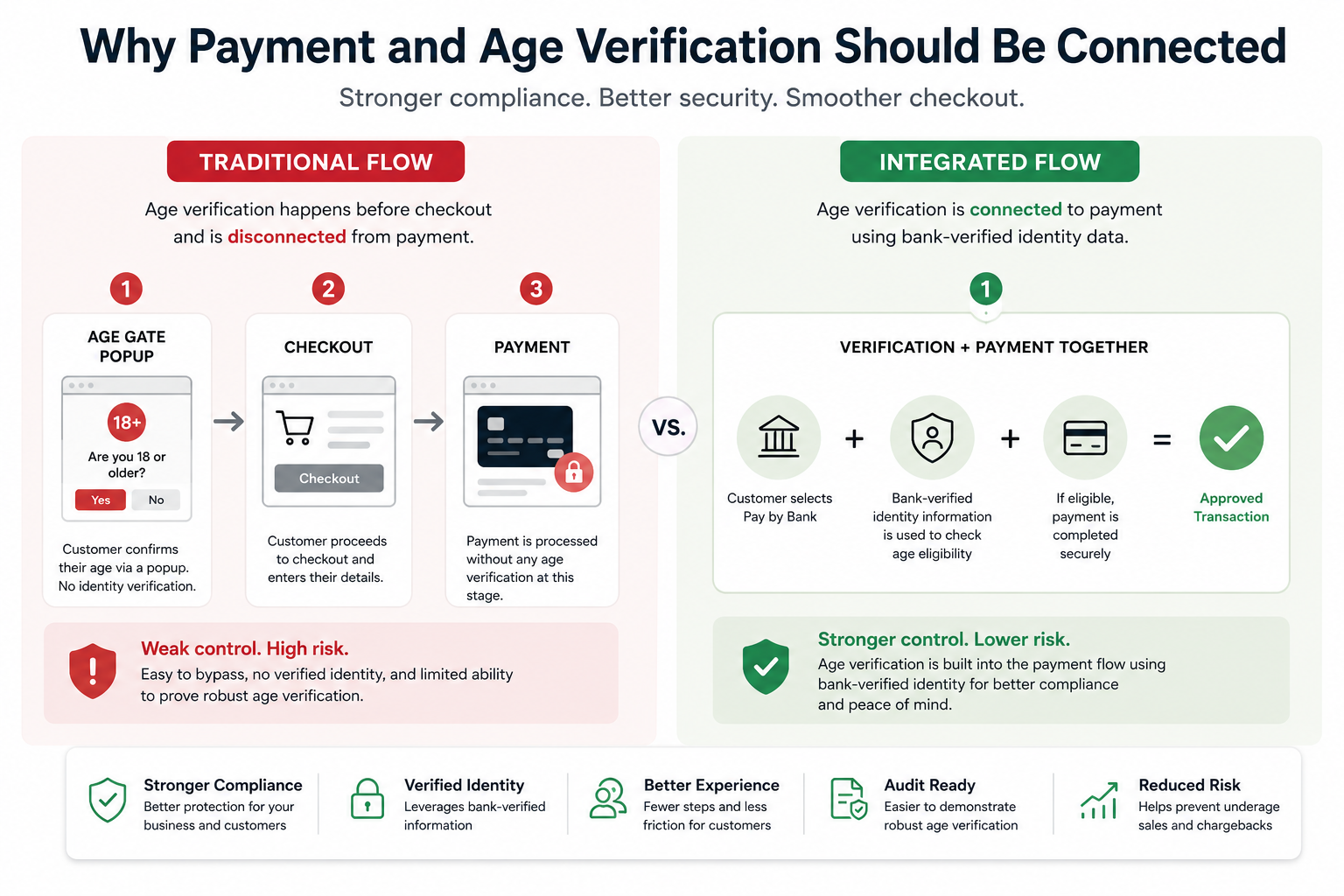
Connecting age verification directly to payment creates a stronger compliance framework. Verification occurs at the moment a customer is attempting to complete a transaction, allowing merchants to make age-related decisions before accepting payment.
For businesses operating in regulated industries, this can provide stronger controls while maintaining a smoother customer experience.
Comparison: Traditional Age Gates vs Pay by Bank Age Verification
This comparison highlights why many regulated merchants are exploring payment-based verification models. By combining age eligibility checks with payment authentication, businesses can streamline compliance controls while reducing customer friction.
Which Product Categories Need Age or Identity Checks?
Age verification requirements vary by country, product category, and regulatory framework. However, many ecommerce businesses across the UK and Europe face age-related compliance obligations.
Common examples include:
Vape and E-Cigarette Products
Many jurisdictions require merchants to verify that customers meet minimum age requirements before purchasing vape products, e-liquids, or nicotine-containing goods.
Alcohol Sales
Online alcohol retailers often need age-verification processes to help prevent sales to underage customers.
Adult Wellness Products
Certain adult-oriented products may require age verification depending on the jurisdiction and product category.
Peptides and Restricted Supplements
Some peptide products, performance-enhancing supplements, and specialist wellness products may face additional scrutiny from payment providers and regulators.
Knives and Bladed Products
Many countries impose strict age restrictions on the sale of knives, blades, and related products.
Fireworks and Pyrotechnics
Firework sales frequently require age verification before a transaction can be completed.
CBD and Other Regulated Goods
Where legally permitted, CBD merchants and sellers of regulated products may need enhanced verification procedures depending on local regulations.
Restricted Digital Products and Services
Some digital goods and online services also require age verification before access can be granted.
Failing to implement appropriate age-verification controls can expose merchants to regulatory investigations, financial penalties, platform restrictions, account termination, and reputational damage.
Why Popup Age Gates Are Weak Controls
Many ecommerce stores still rely on a simple popup asking customers to confirm their age.
While these solutions are inexpensive and easy to install, they provide limited protection.
They Are Easy to Bypass
Most age-gate popups simply ask users to click a button confirming they are over a certain age. There is usually no independent verification.
They Do Not Verify Identity
A popup cannot determine who a customer is or whether the information provided is accurate.
They Create Additional Costs
Many merchants pay monthly subscription fees for age-verification plugins, apps, or third-party services.
They Increase Checkout Friction
Customers are forced to interact with additional screens before shopping or completing a purchase.
They Can Be Difficult to Defend During Audits
When regulators, marketplaces, payment providers, or partners evaluate compliance controls, merchants may need stronger evidence than a self-declared age confirmation popup.
As regulatory expectations continue to evolve, many businesses are looking for more reliable approaches.
How Wallid Pay by Bank Age Verification Works
Wallid combines Pay by Bank payments with identity-based verification capabilities to support regulated ecommerce businesses.
Rather than relying on self-declared age confirmations, the verification process can use bank-verified identity information available through supported Open Banking connections.
The process typically works as follows:
- The customer selects Pay by Bank at checkout.
- The customer authenticates with their bank.
- Bank-verified identity information becomes available where supported.
- The system evaluates whether the customer meets the merchant's minimum age requirements.
- Eligible customers proceed with payment.
- Underage customers can be blocked before the transaction is completed.
This approach can provide several advantages:
Age Verification Within Checkout
Customers do not need to complete a separate verification journey before payment.
Reduced Dependence on Additional Apps
Merchants can reduce reliance on standalone age-verification tools and plugins.
Stronger Verification Signals
Verification is based on bank-verified identity information rather than self-reported declarations.
Better User Experience
Customers complete payment and verification through a single integrated process.
Improved Compliance Controls
Merchants gain access to stronger controls that can support regulatory and operational requirements.
Platform-Agnostic Integration for Modern Commerce
Regulated ecommerce is no longer limited to traditional online stores.
Many merchants now operate across multiple channels, platforms, and custom environments.
Wallid's API-first approach allows age verification and Pay by Bank functionality to be integrated into a wide range of systems.
Custom Ecommerce Stores
Businesses with fully custom storefronts can integrate payment and age-verification workflows directly into their checkout experience.
Headless Commerce Platforms
Modern headless architectures can incorporate verification and payment logic through API integrations.
AI-Built Storefronts
Merchants using AI-generated storefronts and custom commerce experiences can embed age verification into checkout flows.
Online Marketplaces
Marketplace operators can implement age controls for regulated sellers and product categories.
Ecommerce Platforms
The API can support merchants operating on platforms such as Wix, Webflow, Squarespace, BigCommerce, and similar ecommerce ecosystems.
Private B2B Portals
Businesses selling regulated products through private ordering systems can add verification controls directly into purchasing workflows.
Why Regulated Merchants Are Exploring Payment-Based Verification
Traditional verification solutions often require multiple vendors, separate workflows, and additional customer steps.
A payment-centric approach can simplify the process by combining:
- Payment collection
- Customer authentication
- Identity verification
- Age eligibility assessment
- Compliance controls
This can reduce operational complexity while improving the customer experience.
For regulated ecommerce businesses, consolidating critical checkout functions into a single flow can improve both efficiency and compliance outcomes.
Conclusion
Age verification is becoming an increasingly important part of regulated ecommerce operations.
Simple popup-based controls often provide limited assurance and can introduce unnecessary friction into the customer journey. By connecting age verification directly to the payment process, merchants can create a stronger compliance framework while improving checkout efficiency.
Wallid Pay by Bank enables regulated ecommerce businesses to combine secure payment acceptance with age-verification capabilities supported by bank-verified identity information, helping merchants create safer and more compliant checkout experiences.