
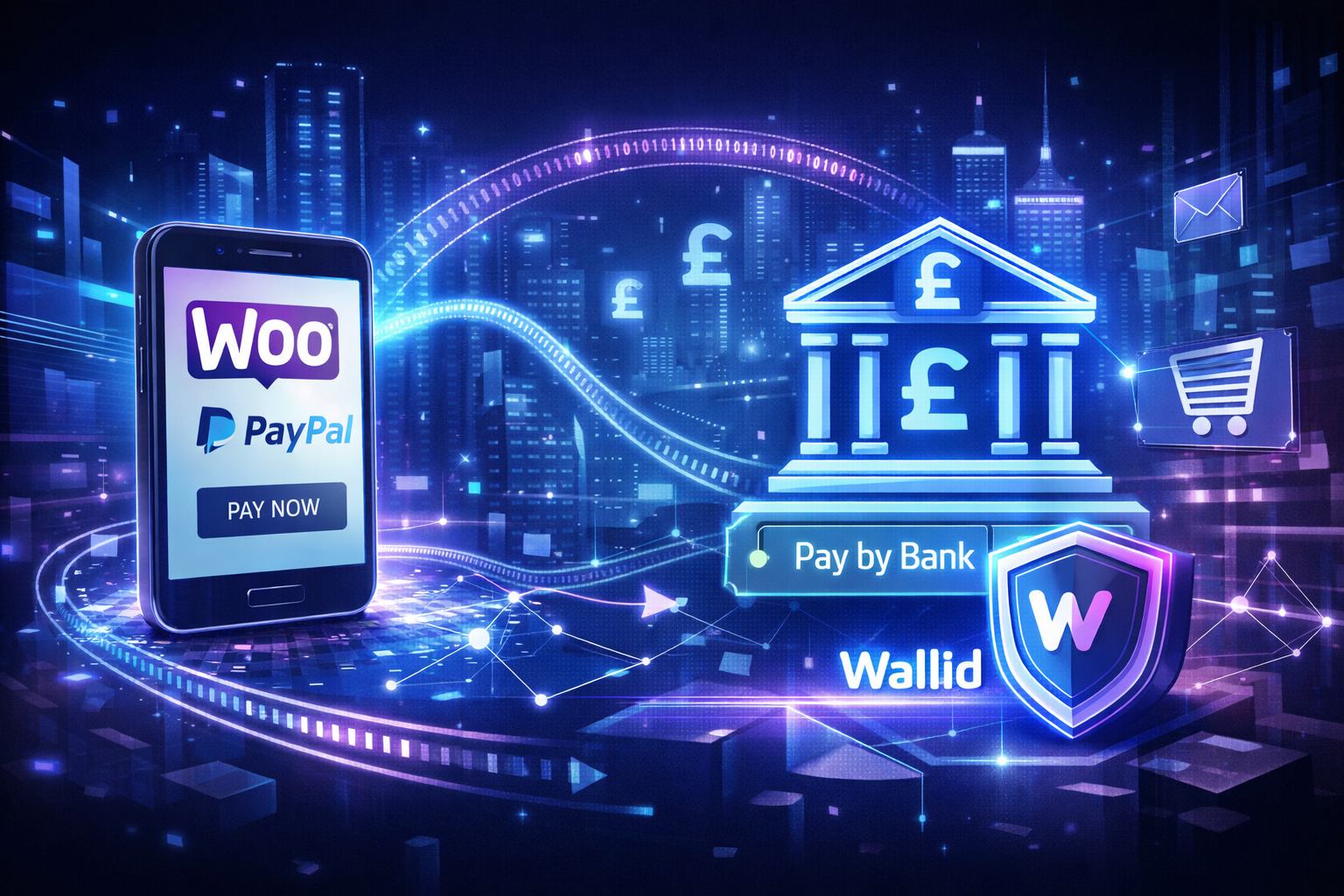
What is PayPal as a payment method?
PayPal payments are a digital wallet-based payment method. When customers choose PayPal at checkout, they are not paying you directly from their bank or card in the same way as a standard card transaction.
Instead, the payment flows through the customer’s PayPal account. PayPal authorises the transaction, processes it within its own system, and then settles funds to the merchant’s PayPal account.
This makes PayPal an intermediary account-based method.
For WooCommerce merchants in the UK, this distinction matters. You are not only accepting a payment option; you are entering a relationship where both buyer and seller operate within PayPal’s account ecosystem.
How PayPal works in WooCommerce
When you accept PayPal in WooCommerce, the typical flow looks like this:
- Customer selects PayPal at checkout.
- Customer is redirected or presented with a PayPal login interface.
- Customer approves the payment inside their PayPal account.
- PayPal confirms the transaction back to WooCommerce.
- Funds are credited to your PayPal merchant account.
Behind the scenes, the customer may be funding the payment via card, bank account, or PayPal balance. However, from your perspective as a merchant, the counterparty is PayPal — not the customer’s bank.
This structural layer is what differentiates PayPal from direct bank-based payment methods.
PayPal is not a gateway
A common misconception is that PayPal is simply another payment gateway.
A gateway connects your checkout to card networks and acquiring banks. It facilitates card processing.
PayPal, by contrast, is itself the payment method. It operates as a closed-loop wallet system with its own accounts, balances, and internal controls.
Understanding this prevents confusion when merchants analyse fees, disputes, account reviews, or fund availability. Those dynamics are tied to PayPal’s platform model — not traditional card acquiring mechanics.
Account-level dependency
When you accept PayPal online payments, your ability to receive and access funds depends on your PayPal account standing.
This creates account-level dependency:
- Merchant access to funds is controlled at the PayPal account level.
- Reviews or compliance checks can affect payout timing.
- Platform rules apply independently of WooCommerce settings.
For UK merchants, this means operational risk is partially externalised to a third-party wallet provider.
This does not make PayPal unreliable by default, but it does mean reliability is mediated by account status and platform governance.
For detailed cost structures and transaction mechanics, refer to Article 3 – Fees & Transaction Costs.
Multi-step checkout and conversion impact
PayPal checkout often introduces additional steps compared to embedded card forms.
Depending on configuration, customers may:
- Be redirected away from your checkout.
- Log into their PayPal account.
- Approve the transaction in a separate interface.
Each additional step can introduce friction.
For some UK merchants, PayPal improves trust and increases conversion among customers who prefer wallets. For others, especially in high-speed retail environments, multi-step flows can increase cart abandonment.
Conversion impact depends on audience behaviour, device mix, and transaction value.
For a broader analysis of checkout friction and abandonment drivers, see Article 4 – Cart Abandonment & Conversion.
Reversal and dispute exposure (high-level)
Because PayPal operates as an intermediary, disputes and reversals may occur within its ecosystem.
This means:
- The dispute process may begin inside PayPal.
- Funds can be affected while a review is ongoing.
- Resolution follows PayPal’s platform policies.
This is structurally different from pure bank transfers, where payments are typically irrevocable once settled.
Detailed protection rules and fee implications should be reviewed in Article 3 – Fees & Transaction Costs.
PayPal payments UK: when they make sense
For UK WooCommerce merchants, PayPal payments can be effective when:
- Customers actively trust and prefer wallet-based payments.
- International buyers expect PayPal at checkout.
- Brand familiarity reduces hesitation during purchase.
PayPal can also increase perceived buyer protection, which may support conversion in trust-sensitive categories.
However, merchants should evaluate PayPal as one component of a broader payment stack — not as a standalone solution.
The full ecosystem context is explained in Article 6 – Payment Methods & Options.
A structural alternative: direct account-to-account payments
Unlike wallet-based systems, pay-by-bank enables customers to pay directly from their bank account to the merchant’s bank account.
There is no intermediary wallet balance.
There is no separate account ecosystem governing access to funds.
For UK WooCommerce merchants, this creates a different risk and dependency profile compared to PayPal.
Pay-by-bank does not replace cards or wallets. It complements them by offering a direct payment rail for customers comfortable authorising payments from their bank.
To understand how pay-by-bank works in WooCommerce and where it fits structurally, see Article 8 – Pay-by-Bank Explainer.
Final perspective
PayPal payments are not simply another technical integration inside WooCommerce. They represent participation in a wallet-based payment ecosystem where both customer and merchant operate through PayPal accounts.
For UK merchants, the decision to accept PayPal should be based on structural understanding:
- Intermediary model
- Account-level dependency
- Checkout flow implications
- Platform-governed dispute exposure
When evaluated clearly, PayPal can be positioned appropriately within a broader payment architecture — alongside cards and direct bank-based methods — rather than misunderstood as just another gateway option.