
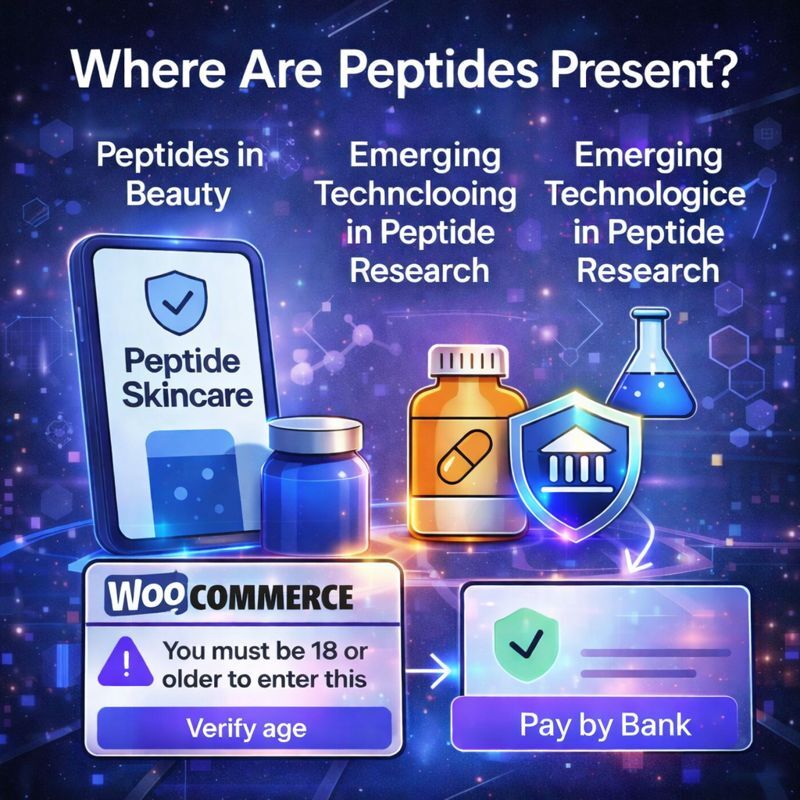
Selling peptide-related products online has become increasingly common across research, performance, and specialist supply chains. For WooCommerce merchants, however, growth often comes with friction: payment interruptions, gateway rejections, and compliance uncertainty.
Wallid works closely with merchants operating in regulated and high-risk ecommerce categories, including stores that have experienced sudden payment blocks or gateway shutdowns. The patterns described in this guide reflect recurring issues seen across WooCommerce environments rather than isolated edge cases.
Wallid works closely with merchants operating in regulated and high-risk ecommerce categories, including stores that have experienced sudden payment blocks or gateway shutdowns. The patterns described in this guide reflect recurring issues seen across WooCommerce environments rather than isolated edge cases.
This article is written for WooCommerce store owners who are already selling, or preparing to sell, peptides and are encountering payment barriers. Rather than focusing on consumer benefits, it explains where peptides appear in modern commerce, why payment providers treat these stores as high risk, and what compliant selling looks like on WooCommerce in practice.
UK context: why peptide sellers face heightened scrutiny
Merchants selling peptides to or from the UK often face a higher level of scrutiny from banks and payment providers. UK-based financial institutions apply conservative risk frameworks to products associated with regulated or specialist use cases, particularly when ecommerce transactions lack sufficient context.
For WooCommerce sellers, this means that compliance expectations are shaped less by the platform itself and more by how clearly the store demonstrates control, transparency, and buyer safeguards. Stores that fail to communicate this effectively may encounter payment interruptions even when operating legitimately.
Where peptides appear in modern commerce
Peptides are not confined to a single market. They are distributed across several commercial contexts, each with different regulatory and risk implications for online sellers.
In ecommerce, peptides commonly appear in:
- Specialist research supply catalogues
- Performance and recovery-oriented product ranges
- Laboratory and analytical distribution channels
- B2B-focused online stores serving institutional or professional buyers
From a merchant perspective, the challenge is not the product category itself, but how broadly peptides are associated with regulated use cases. Payment providers and banks rarely distinguish between low-risk and sensitive contexts unless the store is structured with that distinction clearly in mind.
Why peptide stores face payment issues on WooCommerce
WooCommerce gives merchants full control over their storefront, but that control does not extend to payment risk classification. Banks and payment providers assess stores independently of the ecommerce platform they use.
Peptide stores are frequently flagged because:
- The intended use of products is often unclear at checkout
- Product descriptions can resemble regulated or controlled categories
- Cross-border orders increase compliance exposure
- Card-based payment methods offer limited context to banks
When these factors combine, payment providers may block transactions, delay settlements, or terminate accounts entirely. From the merchant’s perspective, this often appears sudden and unexplained, even when the business itself is legitimate.
WooCommerce and restricted product classification
WooCommerce’s flexibility is one of its strengths, but it also places more responsibility on the merchant. Because stores are self-hosted, payment providers rely heavily on storefront signals, checkout configuration, and transaction behaviour when assessing risk.
Unlike marketplace environments with centralised enforcement, WooCommerce merchants must actively design their store to demonstrate compliance. Without these signals, even well-intentioned businesses may be treated as high risk by default.
Unlike hosted platforms, WooCommerce does not impose universal product restrictions. This flexibility is an advantage, but it also shifts responsibility to the merchant.
If a store selling peptides lacks clear compliance signals, payment providers may classify it under restricted or high-risk categories. Common triggers include:
- Ambiguous product purpose
- Missing buyer qualification or age checks
- Inadequate disclosure of intended audience
- Limited transactional transparency
Once a store is classified as restricted, standard gateways may no longer be available, regardless of the merchant’s history or volume.
What compliant peptide selling looks like on WooCommerce
Compliance on WooCommerce is not about avoiding regulation, but about demonstrating control, transparency, and intent.
A compliant peptide store typically includes:
- Clear product positioning that avoids consumer misuse assumptions
- Explicit information about who the products are intended for
- Checkout flows that reflect regulatory awareness
- Verification measures aligned with regional requirements
For merchants in the UK, this also means recognising that banks and payment providers expect ecommerce stores to actively reduce misuse risk, not simply react to enforcement after the fact.
Age verification and buyer controls
One of the most common gaps in peptide ecommerce is the absence of buyer-level controls. Even when products are legally sold, payment providers may expect additional safeguards.
On WooCommerce, this often involves:
- Age verification mechanisms at checkout
- Geographic or regional validation
- Clear buyer declarations
- Transaction-level traceability
These measures are not only about regulation; they are signals to payment providers that the merchant understands and manages risk.
Why most gateways block peptide stores
Traditional card-based gateways are designed for low-risk consumer goods. When faced with categories that involve regulatory sensitivity, they rely on broad exclusion rules rather than nuanced assessment.
For peptide merchants, this results in:
- Accounts approved initially, then blocked after review
- Sudden payment freezes during growth phases
- Requests for documentation that do not align with the store’s structure
Once a gateway has blocked a store, recovery is difficult. Many merchants discover the issue only after transactions begin failing, at which point revenue disruption is already underway.
A more stable approach: bank transfer payments on WooCommerce
For WooCommerce merchants selling peptides, bank-based payment methods offer a different risk profile. Unlike cards, bank transfers provide greater transaction context and reduce ambiguity for financial institutions.
A bank transfer checkout can:
- Reduce chargeback exposure
- Improve transaction transparency
- Align more closely with regulated product expectations
- Support higher-value or repeat orders
When combined with verification and compliance controls, this approach allows merchants to continue operating even when card gateways are no longer available.
Enabling compliant payments on WooCommerce
Merchants who have experienced gateway blocks often assume the issue is temporary. In reality, long-term stability requires rethinking how payments are accepted.
A WooCommerce-native payment setup for peptide stores focuses on:
- Payment methods that tolerate regulated categories
- Built-in verification and traceability
- Clear alignment with bank expectations
This approach is designed to restore payment continuity while reducing the likelihood of future interruptions.
Peptide seller compliance checklist
Before scaling a peptide store on WooCommerce, merchants should confirm that the following elements are in place:
- Products are clearly positioned and documented
- Buyer eligibility is addressed at checkout
- Payment methods align with regulated product risk
- Transactions are traceable and transparent
- The store structure reflects compliance awareness
Addressing these points proactively reduces the risk of sudden payment blocks and operational disruption.

