
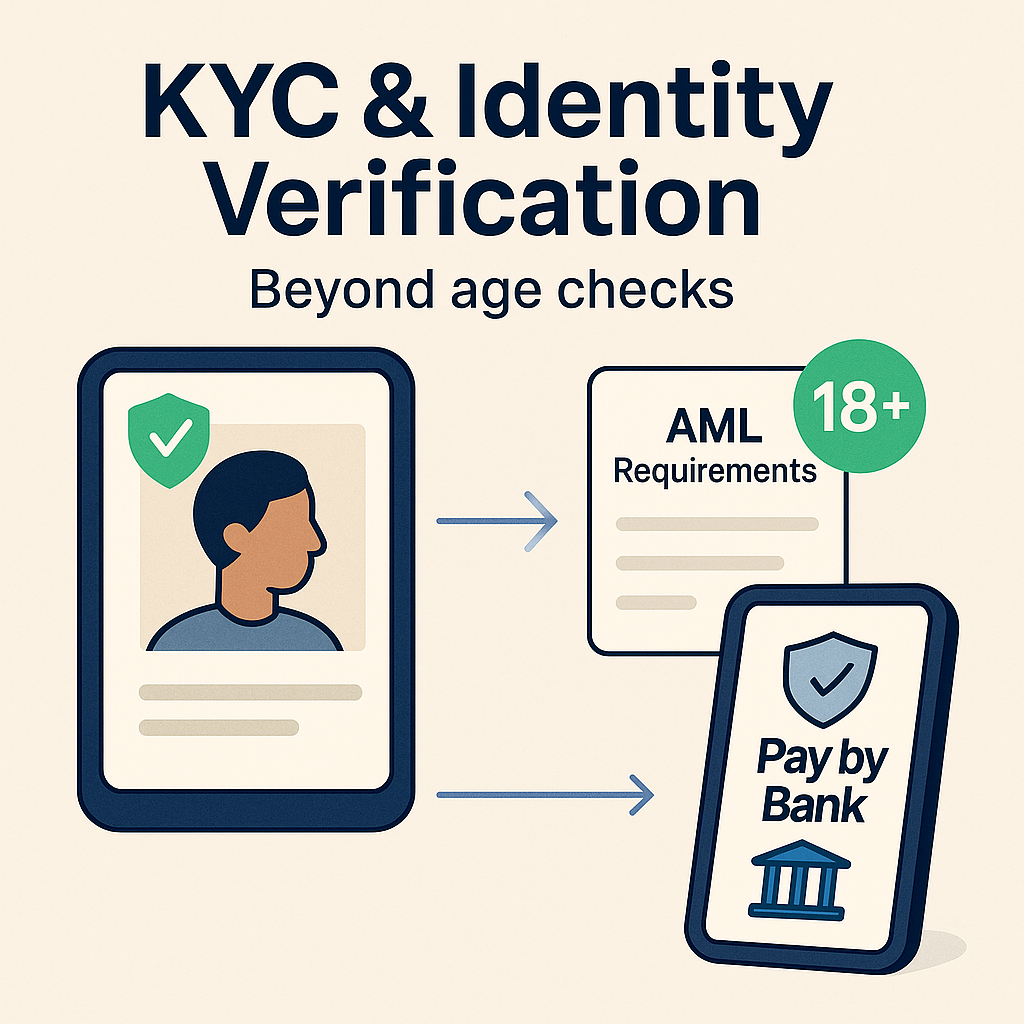
Selling peptides or other research-only compounds in the UK now requires far more than a simple 18+ age gate at checkout, as regulatory bodies expect robust KYC verification, full identity checks, and in higher‑risk cases customer due diligence aligned with AML requirements. This shift is driven both by regulatory tightening around online safety, anonymous buyers, and cross‑border payments, as well as market trends in which peptide retailers aim to reduce fraud, chargebacks, and non‑compliant purchases. This guide explains what KYC actually involves, why age verification alone is insufficient, and how Open Banking verification has become an effective low‑friction method for maintaining compliance and buyer trust.
What Is KYC?
KYC (Know Your Customer) is a verification process that confirms a buyer’s identity, ensuring they are who they claim to be.
For most peptide sellers, KYC is not simply a legal hoop—it's a risk-management necessity.
KYC verification includes:
- Identity verification
- Customer due diligence (CDD)
- Screening for fraud or suspicious behaviour
- Validating financial or payment sources (where required)
In the UK, KYC ties directly into AML requirements, fraud prevention, and now Online Safety Act UK expectations for online merchants who sell restricted or high-risk goods.
Age Verification vs Identity Verification
Many peptide sellers assume that age verification UK—commonly done with a DOB self-declaration or a credit-reference database check—is sufficient.
But regulators and payment providers increasingly expect a much deeper identity check.
Age Verification
- Confirms the user is 18+
- Does not confirm their real identity
- Does not meet AML or due-diligence obligations
- Does not reduce fraud or chargebacks
Identity Verification (KYC)
- Confirms the person’s legal identity
- Prevents anonymous purchases
- Supports AML requirements UK
- Protects merchants from chargeback fraud
- Provides audit trails and compliance logs
The Compliance Landscape for Peptide Sellers (UK Requirements)
Even though peptides are not explicitly banned, sellers still fall under several indirect compliance scopes.
FCA Expectations
If a business accepts payments—especially via fintech processors—KYC signals responsible risk management that aligns with FCA expectations for online merchants.
AML Requirements UK
You must be able to demonstrate:
- You know who your customers are
- You prevent suspicious or anonymous purchases
- You store verification evidence securely
- You monitor unusual buying patterns
Selling high-value peptides or bulk orders without KYC can trigger AML flags.
3. Customer Due Diligence (CDD)
CDD is required when:
- High-value transactions occur
- Buyers request bulk orders
- Cross-border transactions look unusual
- A pattern suggests reselling or misuse
For peptide sellers, CDD helps ensure the product remains in the research-only channel.
Online Safety Act UK
Although the Act targets broader online harms, one of its side effects is stricter scrutiny of:
- Identity-sensitive industries
- Restricted goods
- Pseudonymous or anonymous purchases
Retailers who only use age checks risk being considered non-compliant with the spirit of the Act.
Why Peptide Sellers Need Identity Verification (Business Benefits)
Regulatory compliance aside, implementing KYC verification also helps:
Reduce chargebacks
Verifying identity upfront minimises fraudulent purchases and "fake name" disputes.
Prevent misuse
Anonymous purchases increase the risk of peptides being resold or misused. KYC mitigates this.
Build trust
Research-grade buyers and academic institutions prefer reputable vendors who use transparent verification.
Streamline payment approvals
Many modern payment processors favour merchants who apply due diligence, lowering processing risk.
Open Banking Verification: The New Standard
Traditional online identity verification tools rely on databases, credit files, or document uploads.
Open Banking verification solves this.
How It Works
A buyer logs into their bank account during checkout. The merchant receives verified identity attributes, such as:
- Legal name
- Account ownership
- Address (if available)
- Bank-verified account details
This achieves:
- Instant identity verification
- Bank account verification
- Strong customer authentication
- Automatic compliance with AML expectations
- Zero document uploads
Why Peptide Sellers Prefer It
- No abandoned checkouts
- No manual review
- No data storage headaches
- Highly defensible compliance logs
- Works internationally (via cross-border banking frameworks)
Open Banking verification is now one of the most efficient KYC tools for high-risk, research-product eCommerce.
Best Practices for KYC and Customer Due Diligence in the Peptide Sector
1. Replace age checks with full identity verification
Don’t rely on 18+ buttons or database-only checks.
2. Use risk-tiered KYC
- Low-value orders → Basic KYC
- Repeated orders → Medium-tier screening
- Bulk orders → CDD or enhanced due diligence
3. Prefer Open Banking over document scans
Better UX and higher verification success rates.
4. Create a compliance trail
Store identity verification logs (name, timestamp, outcome).
5. Add transparent disclaimers
Communicate research-only status and discourage consumer use.
6. Keep policies updated
Reflect Online Safety Act UK guidance and AML requirements UK.
Bringing It All Together
The UK peptide market is expanding, but so are compliance expectations. Age checks alone are no longer acceptable.
Retailers need identity verification, KYC processes, and CDD workflows that align with:
- AML requirements UK
- KYC verification standards
- FCA expectations
- Online Safety Act UK principles
With tools like Open Banking verification, peptide sellers can balance low-friction checkout, regulatory compliance, lower fraud risk, and higher customer trust.

