
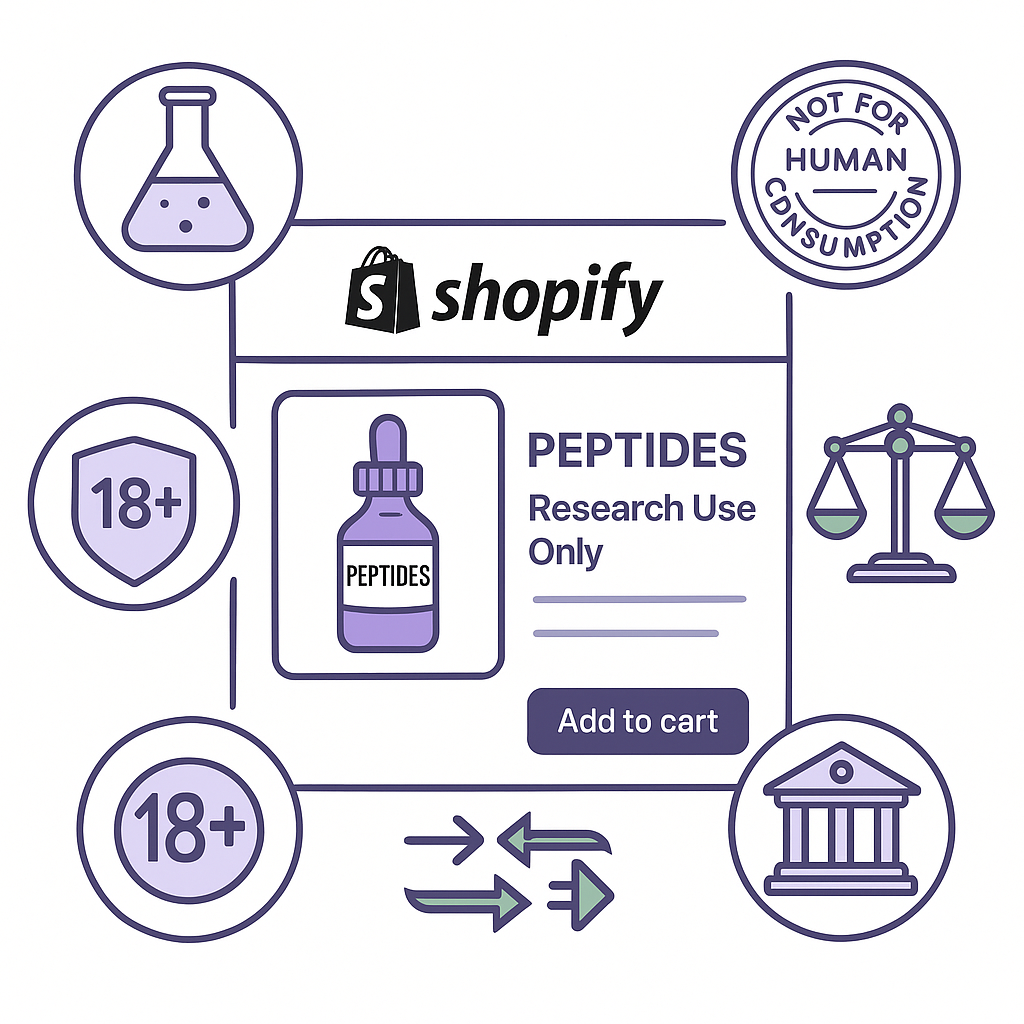
Selling research peptides online requires more than adding a “research use only” disclaimer to a product page. The legal and commercial requirements depend on how the product is classified, how it is marketed, where it is sold, what claims are made, and which payment and e-commerce services are used.
This article is about the main legal, regulatory, and operational considerations for selling research peptides online in the UK and EU. It explains how product classification, intended use, Novel Food rules, marketing claims, Shopify eligibility, payment processing, labelling, testing, and shipping requirements can affect whether and how a peptide business operates.
For UK and EU merchants, the safest approach is to establish the product's regulatory status first, then review labelling, marketing claims, ecommerce-platform rules, payment processing and shipping requirements.
For UK and EU merchants, the safest approach is to establish the product's regulatory status first, then review labelling, marketing claims, ecommerce-platform rules, payment processing and shipping requirements.
Can you legally sell research peptides online?
It may be possible to sell certain peptide products online, but legality depends on the product, intended use, claims, and country.
A peptide marketed as a laboratory research material is not automatically regulated in the same way as a food supplement or medicinal product. Conversely, describing a product as “research only” does not automatically remove other regulatory obligations.
Before launching a store, determine:
- what the product actually is and how it is classified;
- whether it is intended for human consumption or another use;
- whether your marketing makes health, therapeutic or performance claims;
- whether the product falls under food, novel-food, medicinal-product, chemical or other rules;
- which countries you intend to sell into;
- whether your ecommerce platform and payment provider support the business.
For EU sales, the European Commission's Novel Food system applies to foods that meet the relevant definition, and businesses are responsible for determining whether a food is novel. The Commission's Novel Food Catalogue is a non-binding orientation tool, while national authorities can be consulted where the status is uncertain.
Research peptides vs supplements: why the distinction matters
One of the most important questions is whether the product is being marketed as a food or supplement, or as a research material.
If a product is marketed for human consumption, food and supplement legislation may become relevant. In the EU, Novel Foods generally require authorisation before they can be placed on the market, subject to the applicable rules and exceptions. The EU maintains a Union List of authorised Novel Foods and a separate Novel Food status catalogue.
In Great Britain, the FSA/FSS registers are the primary source for authorised Novel Foods. Since April 2025, authorised products are published through the regulated-products register following the applicable authorisation process.
If a product is marketed as a research material, the merchant still needs to ensure that the product description, intended use, advertising and overall business model accurately reflect that purpose.
Do not assume that a disclaimer alone determines the legal classification.
UK requirements for peptide sellers
The UK should be treated separately from the EU because the regulatory framework is no longer identical.
For products marketed as foods or supplements in Great Britain, merchants should check the applicable FSA requirements and the current register of authorised Novel Foods.
For products positioned as research materials, review:
- product classification;
- intended use;
- product descriptions;
- labelling;
- advertising claims;
- import and shipping requirements;
- applicable platform policies;
- payment-provider eligibility.
Avoid presenting research peptides as treatments, medicines, disease cures or performance-enhancing products unless you have verified that the relevant claims and products are legally authorised.
EU requirements: there is no single “EU peptide licence”
Selling across Europe does not mean that one generic “EU peptide approval” automatically covers every product and business model.
For products marketed as food, the EU Novel Food framework can apply. The European Commission maintains both a Novel Food status catalogue and a Union List of authorised Novel Foods. National authorities may also have a role in determining Novel Food status.
The applicable rules can also differ depending on the product's intended use.
For example, the European Medicines Agency defines a medicinal product by its intended purpose and pharmacological, immunological or metabolic action, including products intended to treat, prevent or diagnose disease.
For this reason, European sellers should identify the countries they intend to serve and verify the applicable national requirements rather than treating “EU compliant” as a single blanket status.
Product information, testing and COAs
Clear product information is important for both compliance and customer trust.
Depending on the product and applicable rules, merchants may need to provide or maintain:
- accurate product identification;
- ingredient or composition information where required;
- appropriate labelling;
- batch information;
- independent laboratory testing;
- Certificates of Analysis (COAs);
- storage and handling information;
- accurate intended-use statements.
COAs can help demonstrate product quality, but a laboratory report does not by itself make an otherwise non-compliant product legal to sell.
Marketing and advertising claims
Marketing claims can change how regulators, platforms and payment providers view a product.
Avoid unsupported claims that a peptide:
- treats or cures a disease;
- replaces a medicine;
- produces guaranteed medical results;
- increases muscle growth or athletic performance;
- causes a specific physiological outcome.
A product marketed as a research material should not simultaneously be promoted as a consumer health treatment.
This distinction is particularly important when product pages, advertisements and social-media content are reviewed together.
Can you sell research peptides on Shopify?
Shopify and Shopify Payments should be treated as separate questions.
A business may be able to use Shopify while being unable to use Shopify Payments for its particular products or business model.
Shopify's current UK guidance states that certain business types and services are not permitted to use Shopify Payments and directs merchants to the applicable prohibited-business rules. Shopify also notes that some businesses may be legal while still being unsupported by Shopify Payments.
Shopify Payments restrictions can also change and vary by region. Its UK terms state that prohibited and restricted categories can be imposed by law, payment-network rules, Shopify or payment processors, and that the lists may be updated.
Therefore, before launching a peptide store on Shopify:
- Check Shopify's current policies for your country.
- Check whether your products and business model are eligible for Shopify Payments.
- If Shopify Payments is unavailable, investigate supported third-party payment providers.
- Ensure your product descriptions and marketing accurately reflect the business model.
- Review any additional restrictions that apply to Shopify sales channels.
Payment processing for peptide stores
Payment processing is a separate operational issue from product legality.
A business can be legally established while still being unable to obtain a particular payment service. Payment providers use their own risk policies, prohibited-business lists and underwriting requirements.
This is particularly relevant to merchants selling products that payment providers classify as restricted or high risk.
Before choosing a gateway, check:
- whether research peptides are supported;
- whether the provider supports your country;
- onboarding and underwriting requirements;
- transaction fees;
- settlement timing;
- refund handling;
- dispute and chargeback procedures;
- Shopify or WooCommerce integration;
- any restrictions on product claims or categories.
For merchants who cannot use Shopify Payments, a supported third-party payment method such as Pay by Bank can provide another checkout option, subject to the provider's own onboarding and eligibility requirements.
Other operational requirements
Compliance does not end with the product page.
A peptide store should also review:
- refund and returns policies;
- shipping restrictions;
- privacy requirements;
- age-related considerations where applicable;
- product storage and handling;
- international shipping rules;
- customs requirements;
- advertising-platform policies.
Requirements can differ depending on the product and destination country, so merchants should verify them before accepting orders.