
Turn Your Cursor App Into a Revenue-Ready Product
Built your app in Cursor and ready to launch? The next step is simple, but critical: getting paid.
Cursor helps you write and ship code fast, but it doesn’t handle payments. To start charging customers, you’ll need to integrate a payment provider into your application.
The good news? You’re not locked into any one solution. You can choose the payment methods that best fit your business—cards, wallets, subscriptions, or Pay by Bank.
This guide shows you exactly how to do it.
Can Cursor Accept Payments?
No, Cursor doesn’t process payments.
Cursor is an AI-powered code editor, not a payment platform. It doesn’t include:
- A checkout page
- A payment gateway
- A merchant account
- Payment processing
Instead, you connect your app to a payment provider using APIs or SDKs.
That flexibility is a big advantage—you can build your payment stack exactly how you want.
Why Payments Are Separate From Cursor
Building software and processing payments are two different systems.
Cursor helps you build your product. Payment providers handle:
- Secure transactions
- Card and bank payments
- Fraud prevention
- Customer authentication
- Compliance and settlement
This separation keeps your app flexible—but it means you need to add payments before you can monetize.
How Payments Work in a Cursor App
Most integrations follow the same flow:
- Customer selects a product or plan
- Your app creates a payment request
- The provider processes the payment
- You receive confirmation
- Your app updates the user account
Your app controls the experience. The provider handles the money.
Payment Options You Can Add
Choosing the right payment methods can directly impact conversion.
Offering multiple options usually improves checkout completion rates.
Popular Payment Providers
Here are common providers developers integrate with Cursor apps:
Your choice depends on your customers, pricing model, and geography.
When Pay by Bank Is Worth Adding
Pay by Bank lets customers pay directly from their bank account using Open Banking.
Instead of card networks, payments move account-to-account after user approval.
It’s especially useful if you:
- Process high-value transactions
- Want to reduce fees
- Operate in the UK or Europe
- Want fewer chargebacks
- Need faster settlement
Most businesses don’t replace cards—they add Pay by Bank alongside them.
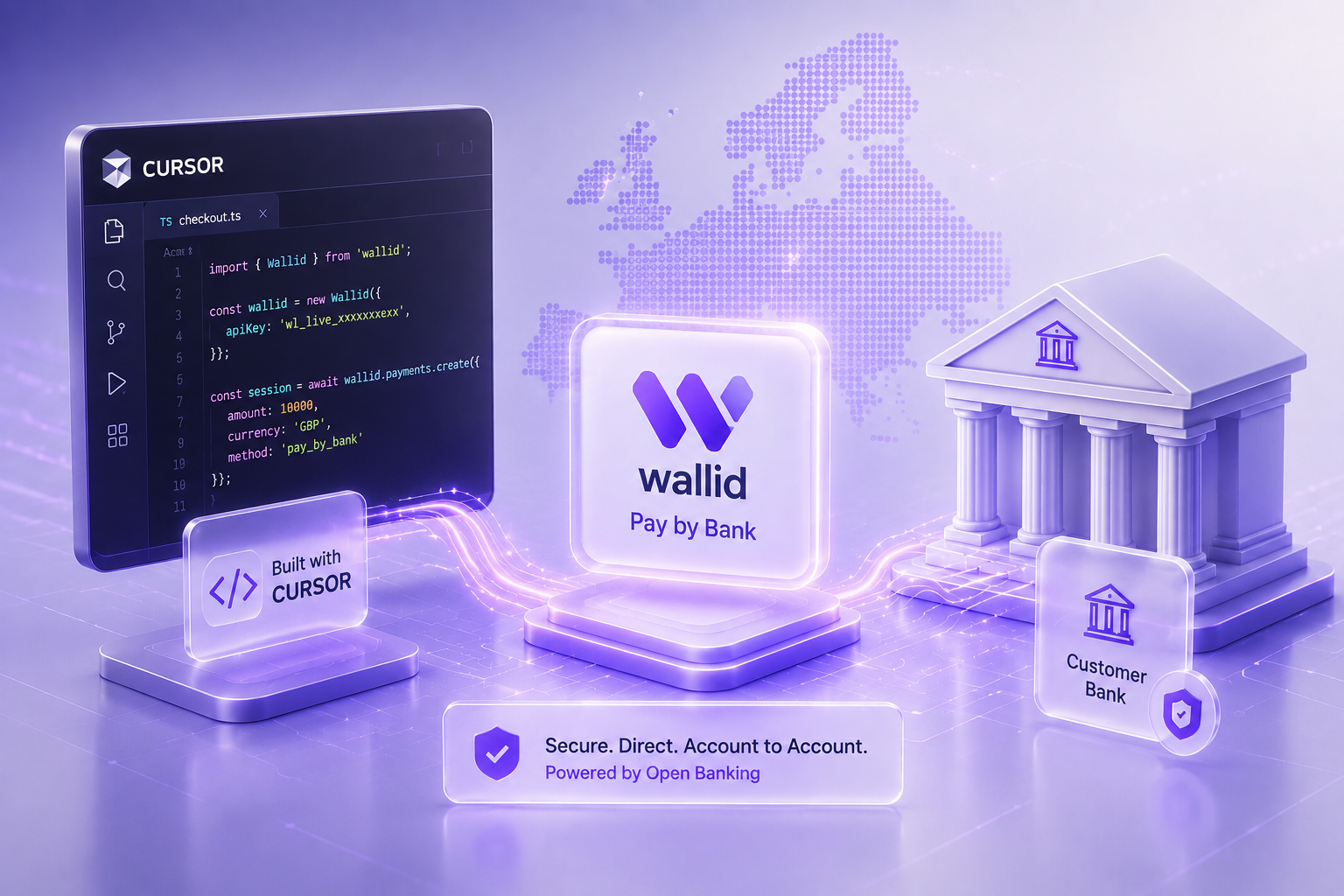
Using Wallid in a Cursor App
Wallid is a Pay by Bank provider designed for UK and European businesses.
You can integrate it into your Cursor-built app via API to:
- Accept direct bank payments
- Offer an alternative to cards
- Reduce payment costs
- Lower chargeback risk
If you later expand to platforms like Shopify or WooCommerce, Wallid also supports those—so your payment setup can scale with you.
How to Add Payments (Step-by-Step)
Getting started is straightforward:
Best Practices That Improve Conversion
Small improvements can make a big difference:
- Offer more than one payment method
- Keep checkout fast and simple
- Don’t store sensitive payment data
- Handle failed payments clearly
- Test webhooks and edge cases
- Monitor performance after launch
A smooth payment experience builds trust—and increases revenue.
Quick Example
Let’s say you’re building a SaaS tool in Cursor.
Your app manages users and subscriptions. Instead of building payments from scratch, you integrate a provider.
At checkout, users choose between card or Pay by Bank. Once payment is confirmed, your app activates their subscription automatically.
You focus on your product. The provider handles the transaction.
Final Thoughts
Cursor helps you build powerful applications—but payments are a separate layer you need to add.
The right payment setup lets you start charging customers quickly while keeping your app flexible.
If you’re targeting the UK or Europe, adding Pay by Bank through a provider like Wallid can reduce costs and give customers another secure way to pay.
Build your product in Cursor. Plug in the right payments. Start generating revenue.

