
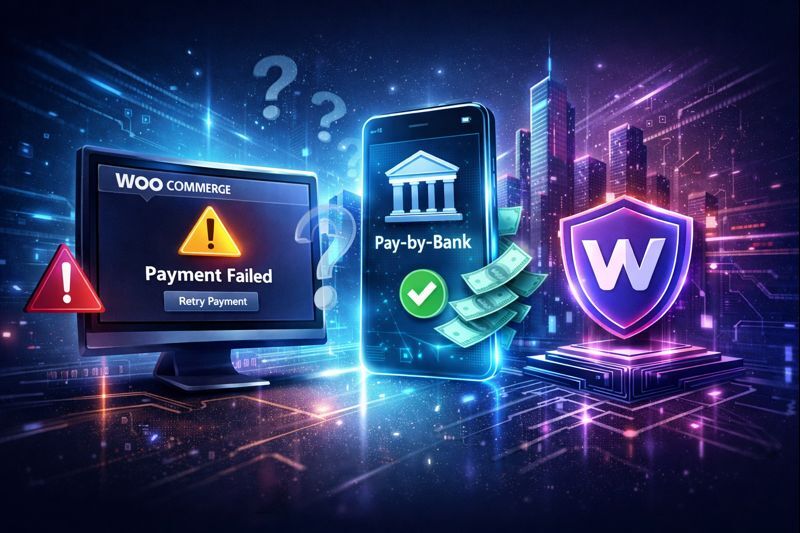
If a customer tells you their payment failed but nothing actually happened, you are dealing with one of the most frustrating WooCommerce payment scenarios.
There is no order. No clear error message. No bank decline. No completed transaction. From the customer’s perspective, they tried to pay and were sent back or dropped out. From the merchant’s side, it looks like nothing occurred at all.
These situations are not rare edge cases. They usually indicate a breakdown somewhere between checkout, the payment gateway, and the customer’s bank, where the payment flow never reached a definitive outcome.
There is no order. No clear error message. No bank decline. No completed transaction. From the customer’s perspective, they tried to pay and were sent back or dropped out. From the merchant’s side, it looks like nothing occurred at all.
These situations are not rare edge cases. They usually indicate a breakdown somewhere between checkout, the payment gateway, and the customer’s bank, where the payment flow never reached a definitive outcome.
This article explains why payments can fail silently, how these failures differ from declines or delays, and what they reveal about the structural fragility of certain payment flows.
What “payment failed but nothing happened” actually means
When merchants describe this issue, they are usually observing one of three limbo states:
- The customer starts a payment, leaves the checkout flow, and never returns
- The gateway initiates a transaction but never confirms it
- The bank is never reached, or the response never comes back
In all of these cases, the key problem is the same: the payment flow never reaches a confirmed success or failure state.
This is different from a normal decline. A decline is explicit. A silent failure is undefined.
If you are seeing frequent payment failures with no traceable outcome, it is important to understand how this differs from other, more visible payment problems.
Silent failure vs declined vs delayed payments
Many payment issues look similar on the surface but behave very differently underneath. The table below compares the three most commonly confused outcomes.
In the last case, WooCommerce receives no definitive success or failure signal. The payment attempt effectively disappears, which is why these situations feel like “nothing happened” and are often misclassified as payment failures rather than incomplete executions.
Why redirect-based payment flows are fragile
Many modern payment methods rely on redirects.
The customer leaves your checkout, completes an action elsewhere, and is then sent back to your store for confirmation. This creates multiple points of failure that are invisible to both merchants and customers.
Common fragility points include:
- The customer closes the browser or app during the redirect
- The bank authentication times out
- The return URL fails to load
- Mobile app handoffs break the flow
- Network or device interruptions
When any of these happen, the payment may technically be initiated but never confirmed.
Unless the payment method provides deterministic confirmation, WooCommerce has no reliable way to know whether the payment succeeded, failed, or was never completed.
This is why these issues feel random. They are not caused by a single bug, but by structural uncertainty in the payment flow itself.
Why there is no order, error, or record
WooCommerce creates orders based on confirmed payment events.
If a payment attempt never reaches a terminal state, WooCommerce cannot safely create an order. Doing so would risk charging customers without confirmation or creating unpaid orders that cannot be reconciled.
As a result:
- No order is created
- No failure message is stored
- No payment record appears in WooCommerce
This is why merchants often assume the system is broken, when in reality it is behaving cautiously in the absence of confirmation.
If you are seeing orders stuck in a visible but unresolved state, your issue is likely different and may fall under pending payments and delayed settlement rather than silent failure.
When this is not a payment problem at all
Not every “payment didn’t go through” report is actually about payments.
If customers cannot submit the checkout form, see validation errors, or never reach the payment step, the issue is likely in checkout execution rather than payment processing.
These problems belong to a different diagnostic category and are covered separately in the guide on checkout not working issues.
Correct classification matters. Treating checkout failures as payment failures leads to the wrong fixes and more confusion.
Why deterministic confirmation matters
The core issue behind silent payment failures is uncertainty.
A robust payment flow ends in one of two clear states: success or failure. Anything else creates reconciliation gaps, support overhead, and lost conversions.
Payment methods that rely heavily on redirects without guaranteed confirmation are structurally more fragile. They shift completion responsibility onto the customer and the device, rather than the system.
This is why merchants dealing with high-value, trust-sensitive, or B2B-style transactions often prioritise payment methods that confirm payments deterministically within the checkout flow.
One example is pay-by-bank, which is designed to reduce ambiguity by confirming payments directly rather than relying on uncertain redirects.
For a deeper explanation of how pay-by-bank works and when it makes sense for WooCommerce merchants, see the dedicated pay-by-bank explainer.
How to diagnose silent failures in practice
When investigating these issues, focus on patterns rather than individual complaints.
Key signals to look for include:
- Drop-offs after redirect steps
- Discrepancies between checkout attempts and gateway confirmations
- High failure reports without corresponding decline data
- Mobile-heavy traffic with higher abandonment rates
These patterns indicate flow fragility, not necessarily misconfiguration or fraud.

