
Furniture ecommerce operates under a different set of economic pressures than most online retail sectors. Order values are higher, delivery logistics are more complex, and refund disputes often involve expensive shipping and bulky goods. For Shopify merchants selling furniture in the UK, choosing the right payment setup is not only about convenience for customers — it directly affects margins, cash flow, and operational risk.
This guide explains the payment challenges furniture stores face on Shopify, the costs associated with common payment methods, and why many high-value ecommerce merchants are evaluating pay-by-bank options alongside traditional payment methods.
Payment Challenges for Furniture Stores on Shopify
Furniture stores typically operate with significantly higher average order values than many other ecommerce categories. Orders commonly range from several hundred pounds to several thousand pounds depending on the type of product being sold.
These larger transactions create several payment-related challenges:
- Percentage-based payment fees scale with order value
- Delivery disputes can trigger expensive chargebacks
- Refunds may involve partial refunds or delivery fee complications
- Payment settlement timing affects inventory purchasing cycles
Unlike small-ticket ecommerce products, where a few pounds of payment processing fees may be negligible, furniture merchants often lose substantial margin to payment costs.
Because of this, the payment mix used on a Shopify furniture store has a direct impact on profitability.
Why Payment Fees Matter for High-Average Order Furniture Stores

High-average-order ecommerce categories such as furniture experience payment costs differently from stores selling low-priced goods. Because each order represents a large monetary value, even small percentage fees can translate into substantial operational costs.
For example, a payment fee of 2–3% applied to a £1,200 order can remove a noticeable portion of the store's margin. When multiplied across dozens or hundreds of orders per month, payment processing becomes a significant operational expense.
Furniture merchants must also consider additional cost drivers associated with payments, including:
- Refund processing costs
- Payment dispute management
- Administrative overhead related to transaction issues
Because furniture items are bulky and expensive to ship, resolving payment disputes can be significantly more complex than for smaller ecommerce goods. For this reason, many furniture merchants evaluate multiple payment options in order to balance customer convenience with long‑term cost efficiency.
Card Payments for Furniture Stores on Shopify
Card payments remain the default option for most Shopify stores. Credit and debit cards are familiar to customers and supported by nearly every ecommerce checkout.
However, furniture merchants often encounter several issues when relying exclusively on card payments:
High percentage-based fees
Because card processors charge a percentage of each transaction, larger orders increase payment costs proportionally.
Chargeback exposure
Furniture purchases can involve delivery delays, assembly questions, or expectations around product appearance. These issues sometimes lead to disputes that escalate into chargebacks.
Administrative overhead
Managing chargeback responses requires documentation, delivery confirmation, and communication with payment providers.
Cards are convenient for customers, but many furniture merchants find that relying solely on card payments can compress already tight retail margins.
Buy Now Pay Later (BNPL) for Furniture Purchases
Buy Now Pay Later providers are commonly offered by furniture stores because they allow customers to spread the cost of large purchases over time.
For shoppers considering a sofa, bed, or dining table, the ability to split payments into installments can increase conversion rates.
However, BNPL providers also introduce their own economic trade-offs for merchants.
Typical considerations include:
- Merchant fees that are often higher than standard card payments
- Operational complexity when refunds or cancellations occur
- Customer service overhead when payment schedules change
BNPL can support higher conversion for expensive products, but the merchant fees associated with these services must be carefully evaluated, particularly for stores with already narrow margins.
Pay-by-Bank Payments for Furniture Stores
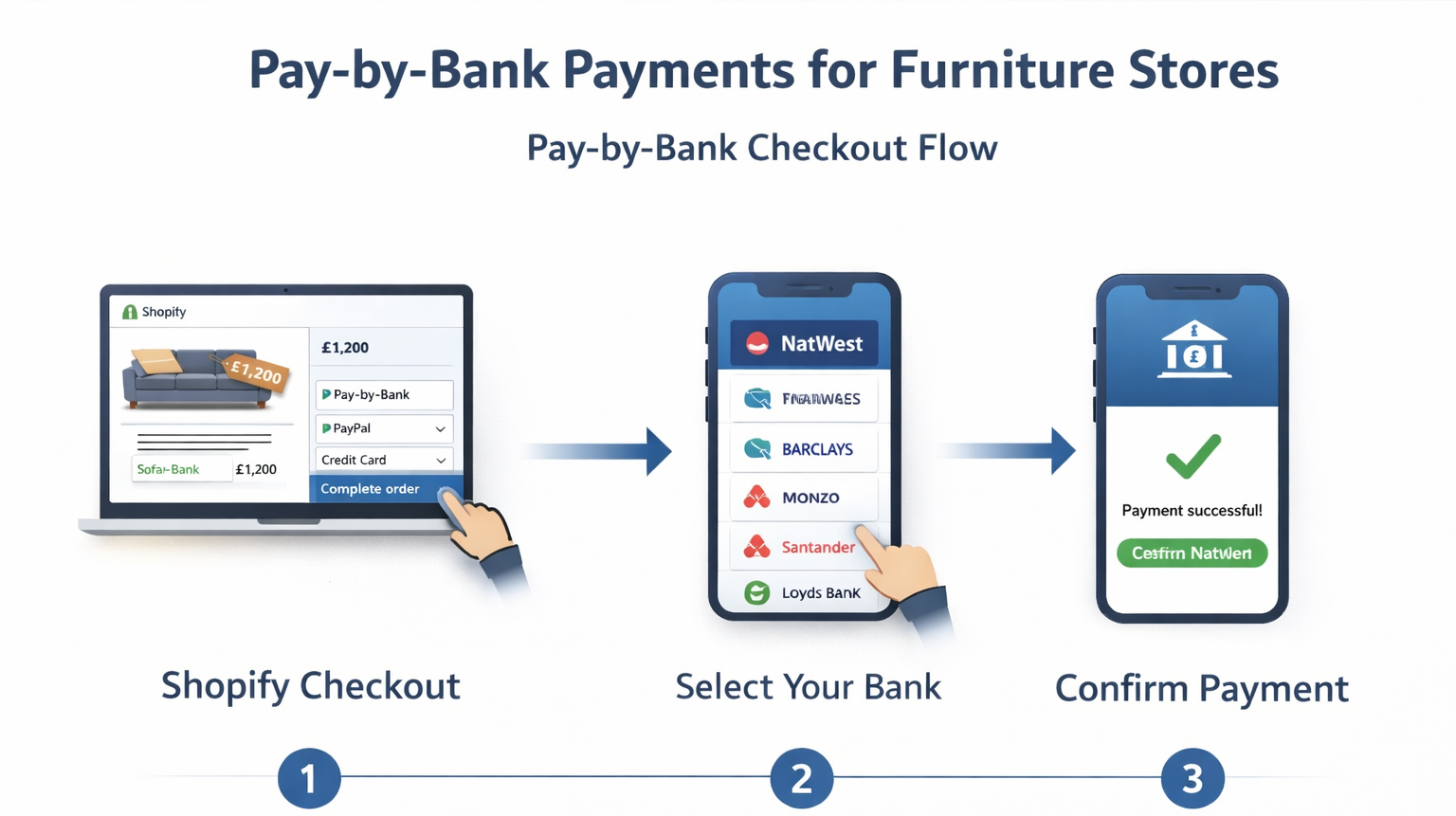
Pay-by-bank payments allow customers to pay directly from their bank account through secure bank authentication instead of using card networks.
For furniture merchants, this model changes the economics of high-value transactions.
Key characteristics include:
Lower transaction costs
Because bank payments bypass traditional card networks, fees are typically lower than card-based transactions.
Reduced chargeback exposure
Bank-authorised payments significantly reduce the likelihood of chargeback disputes compared to card payments.
Fast settlement
Faster settlement can help merchants manage inventory purchasing cycles, particularly when large items must be manufactured or sourced after purchase.
For stores processing high-value orders, even small reductions in transaction fees can result in meaningful improvements to profit margins.
Why Pay-by-Bank Is Often the Best Payment Setup for Furniture Stores
Furniture ecommerce involves a combination of high transaction values, expensive logistics, and complex refund scenarios.
When these factors are combined with percentage-based payment fees, the total cost of payment processing can become significant.
Pay-by-bank payment methods are increasingly used by merchants selling high-ticket products because they offer:
- Lower transaction costs compared to many card payments
- Reduced exposure to chargeback disputes
- Faster access to funds after transactions
While card payments remain important for customer convenience, many furniture stores adopt a mixed payment setup that includes both cards and bank payments in order to balance conversion and cost efficiency.
How to Add Pay-by-Bank to a Shopify Furniture Store
Adding pay-by-bank payments to a Shopify store typically involves integrating a payment provider that supports open banking transactions.
The setup process generally involves the following steps:
- Install the payment provider through the Shopify admin.
- Connect the store's business bank account.
- Configure payment methods displayed at checkout.
- Test the checkout experience to ensure payments process correctly.
Once enabled, customers selecting the bank payment option are securely redirected to their bank to authorise the transaction.
After authorisation, the payment confirmation is returned to the Shopify checkout and the order is completed.
For furniture stores with high-value baskets, offering bank payments alongside card options can improve the economics of payment processing without changing the overall checkout experience for customers.
Choosing the Right Payment Mix for Your Store
The best payment setup for a furniture store on Shopify usually combines multiple payment options to balance customer preference and operational efficiency.
Most stores offer a combination of:
This mixed approach allows customers to choose the payment method they prefer while allowing the merchant to reduce overall payment costs.
For stores selling high-value furniture products, reviewing payment economics regularly can reveal opportunities to improve margins without changing pricing or marketing strategies.
As ecommerce competition increases and margins tighten, payment strategy is becoming an increasingly important operational decision for Shopify furniture merchants in the UK.
Most stores offer a combination of:
- Card payments for universal customer familiarity
- BNPL options to support large purchases
- Pay-by-bank payments to reduce processing costs on high-value orders
This mixed approach allows customers to choose the payment method they prefer while allowing the merchant to reduce overall payment costs.
For stores selling high-value furniture products, reviewing payment economics regularly can reveal opportunities to improve margins without changing pricing or marketing strategies.
As ecommerce competition increases and margins tighten, payment strategy is becoming an increasingly important operational decision for Shopify furniture merchants in the UK.

