
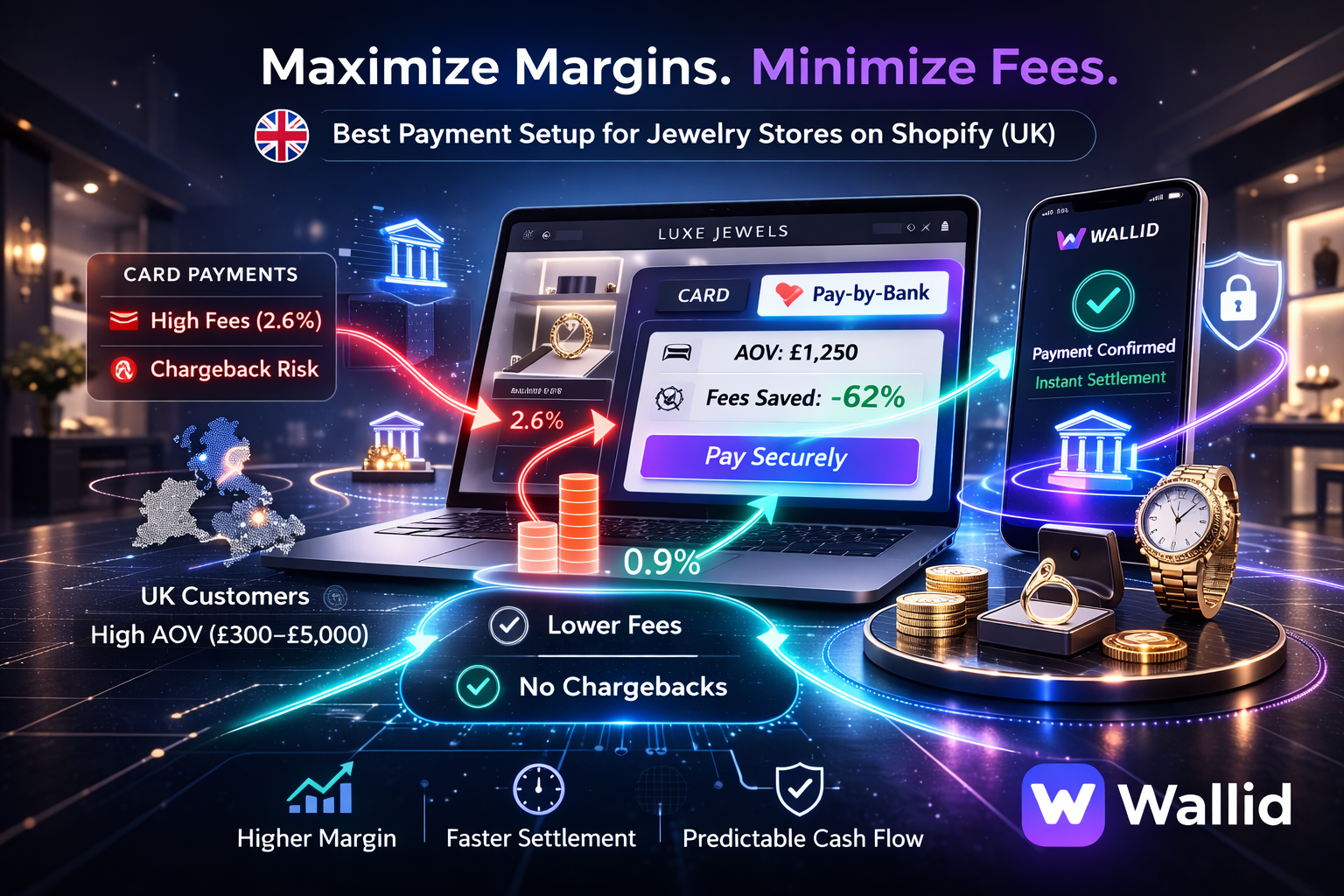
UK jewelry and watch merchants on Shopify typically process orders between £300 and £5,000. At this level, percentage-based card fees and chargeback exposure materially impact margin and cash flow.
A resilient setup combines card payments for coverage with Pay-by-Bank for high-value UK transactions, optionally supported by BNPL for conversion.
This article explains how a hybrid payment structure reduces fee drag, lowers dispute risk, and improves working capital stability for scaling jewelry brands.
What Is the Best Payment Gateway for Jewelry Stores on Shopify in the UK?
The best payment setup for a UK jewelry store on Shopify is a hybrid model:
- Card payments via Shopify Payments for broad domestic and international acceptance
- Pay-by-Bank for UK customers placing high-value orders
- Optional BNPL for conversion optimisation on mid-range products
For jewelry merchants operating between £300 and £5,000 average order value (AOV), payment economics, fraud exposure, and settlement timing materially impact profitability. A blended payment stack reduces fee drag, lowers chargeback risk, and improves working capital predictability.
Why Jewelry Stores Have Different Payment Economics
Jewelry and watch merchants are structurally different from low-ticket ecommerce businesses.
High Average Order Value Sensitivity
At £300–£5,000 AOV, percentage-based card fees scale aggressively.
A 2.5% blended card fee on:
- £300 = £7.50
- £1,200 = £30.00
- £5,000 = £125.00
Unlike low-ticket merchants, fee compounding directly erodes gross margin on each transaction.
Elevated Fraud Attractiveness
High-value portable goods are attractive to fraudsters due to:
- Strong resale markets (particularly luxury watches)
- Emotional purchase categories (engagement rings, gifts)
- Insurance and authenticity disputes
Card networks allow post-settlement reversals, increasing exposure to:
- "Item not as described" claims
- Friendly fraud
- Chargeback arbitration cycles
Operational Impact of Disputes
A single £2,000 chargeback is not only lost revenue. It often includes:
- Product loss
- Processing fees
- Chargeback penalty fees
- Operational overhead
For scaling brands, dispute ratios can trigger account monitoring or reserve requirements.
Shopify Fees for Jewelry Stores in the UK
Most UK Shopify jewelry stores use Shopify Payments with card processing.
Typical blended effective cost: 2.4%–2.9% + fixed fee component.
Worked Example
Assume:
- AOV: £1,200
- Orders per month: 100
- Blended card fee: 2.6%
Per-transaction fee: £31.20
Monthly fee cost: £3,120
If 40% of UK orders shift to Pay-by-Bank at an assumed 0.9% fee:
- 60 card orders: £1,872 in fees
- 40 bank orders: £432 in fees
- Total blended monthly fees: £2,304
Estimated monthly savings: £816
Estimated annual savings: £9,792
At higher AOV bands, savings compound further.
Fee Comparison Matrix (Illustrative)
The higher the AOV, the greater the structural benefit of reallocating domestic transactions away from percentage-heavy card rails.
Chargebacks and Jewelry Stores on Shopify
Jewelry merchants experience higher-than-average dispute sensitivity due to:
- Authenticity disagreements
- Quality perception differences
- Delayed delivery for custom pieces
- Emotional purchasing decisions
With card payments:
- Customers can initiate disputes post-settlement
- Funds may be temporarily withdrawn
- Outcomes are decided by card network arbitration
This creates revenue uncertainty and operational friction.
Pay-by-Bank transactions, once authorised and settled, do not follow traditional card chargeback mechanics. This materially reduces post-settlement reversal exposure.
Risk Exposure Comparison
For high-ticket jewelry transactions, structural differences in dispute mechanics materially affect revenue stability.
Settlement Speed and Working Capital Impact
Cash flow is critical for jewelry merchants due to inventory concentration.
Card settlements typically occur within 2–5 business days. In periods of elevated disputes, additional monitoring or rolling reserves may be applied.
For merchants holding high-value inventory, delayed settlement impacts:
- Reordering cycles
- Supplier payment schedules
- Marketing reinvestment
- Inventory turnover velocity
Direct bank payments typically settle faster and reduce reversal risk, improving working capital predictability.
Recommended Payment Architecture for UK Shopify Jewelry Stores
An optimised payment stack should balance acceptance coverage and economic efficiency.
Core Layer
- Shopify Payments for card acceptance (Visa, Mastercard, international buyers)
Margin Protection Layer
- Pay-by-Bank option for UK customers, especially on orders above £500
Conversion Layer (Optional)
- BNPL for mid-range products where instalment psychology improves conversion
Risk Layer
- Fraud monitoring tools
- Clear product documentation
- Strong fulfilment and tracking workflows
This blended approach reduces fee concentration risk while maintaining broad payment acceptance.
Is Pay-by-Bank Better Than Cards for Jewelry Stores?
For high-ticket domestic UK transactions, Pay-by-Bank often provides:
- Lower percentage-based fees
- Reduced chargeback exposure
- Faster, more predictable settlement
Cards remain important for:
- International customers
- Buyer familiarity
- Cross-border sales
The optimal approach is not replacement, but allocation. High-value UK orders are economically better suited to direct bank payments, while cards provide coverage breadth.
Final Recommendation
For UK jewelry and watch merchants on Shopify operating between £300 and £5,000 AOV, the most resilient setup is a hybrid payment model.
Overreliance on percentage-based card rails compounds fees and increases dispute exposure. Introducing Pay-by-Bank as a primary option for domestic high-ticket transactions protects margin and stabilises cash flow without sacrificing conversion coverage.
For a broader strategic view of payment economics in the jewelry sector, see the Jewelry & Watches UK pillar article.